

On October 2, 2026, a link to a Fortnite tournament sign-up page was submitted to the Cybersecurity Reach Foundation as a suspected scam. It replicated Epic Games’ sign-in screen, but the address did not belong to them.
Three days later, on October 5, we opened the same link again, but the sign-in page was gone. Instead, the server returned a long error page. Normally, a site would show a short, generic “page not found” message, but this one printed out the name of its project folder, the exact line of code that failed and its settings, including the location of its database and a note that it was running in a developer’s debug mode. A second error page, saved shortly after, listed every web address the site answers to.
That mistake allowed the researchers at the Cybersecurity Reach Foundation a look inside a phishing kit that its code calls EpicFishing. Its error pages laid out the fake offers it uses to lure players (tournaments, giveaways and trade offers), a hidden control panel, where it keeps its data, and a single server that appears to host two of its three sites.
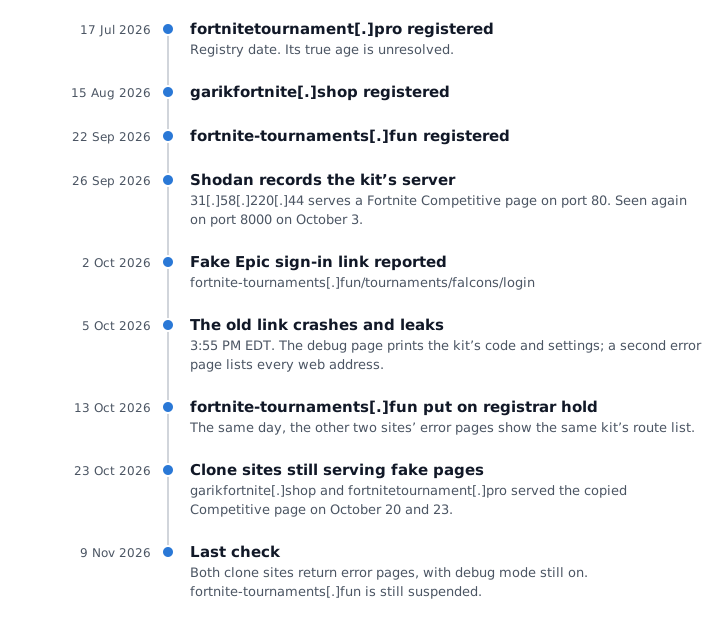
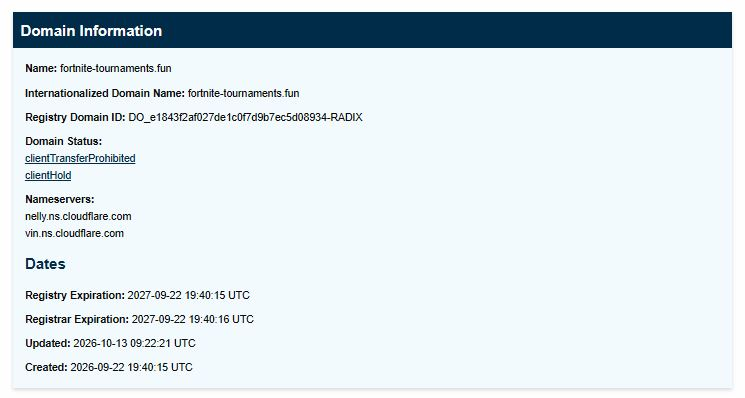
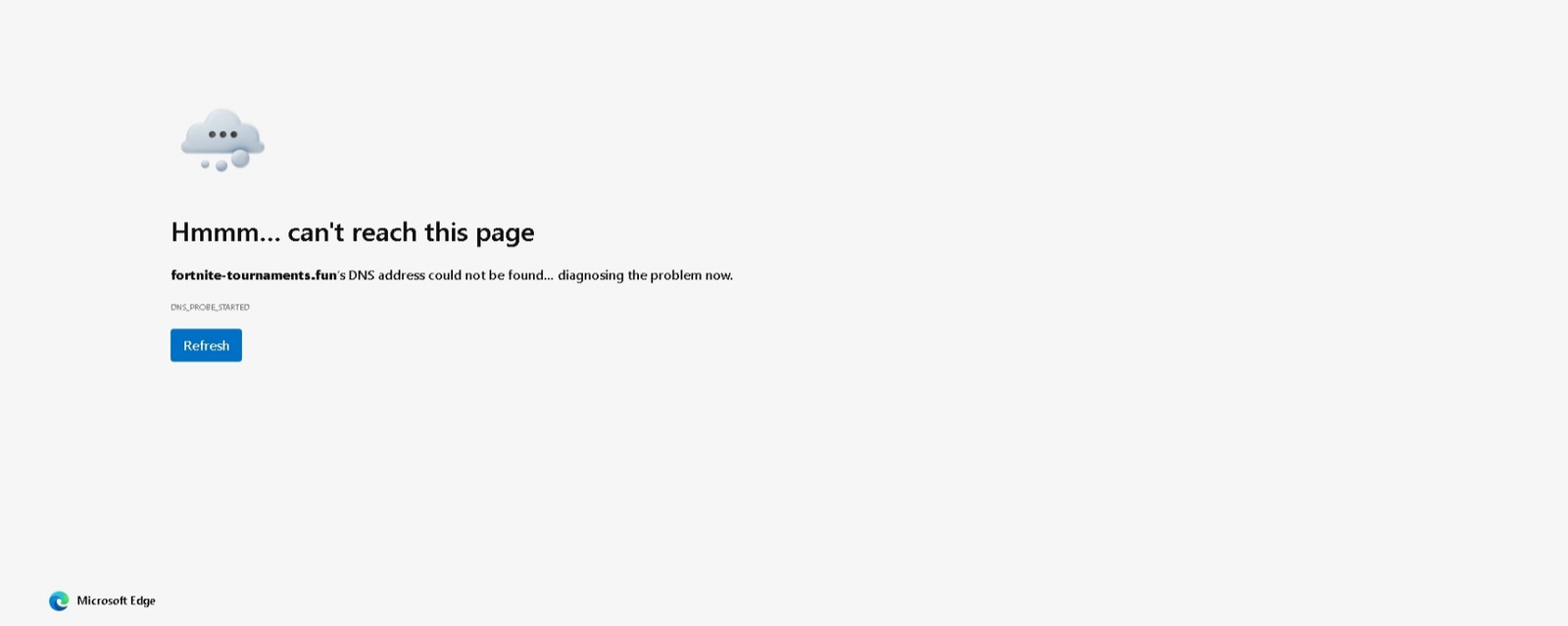
Three sites match the kit. fortnite-tournaments[.]fun came in with the original report. The kit’s leaked settings named garikfortnite[.]shop, and a the Fortnite logo on that site led to fortnitetournament[.]pro. The three were registered between July 17 and September 22, 2026: fortnitetournament[.]pro on July 17, garikfortnite[.]shop on August 15, and fortnite-tournaments[.]fun on September 22, nine days before it was reported. On October 13, the registry record for fortnite-tournaments[.]fun was updated with a registrar hold, and it remained suspended on November 9. On October 23, the other two sites were serving the fake Epic page. By November 9, both still resolved but returned an error page instead, with debug mode still on.
The pages show how the kit is built, but not who built it, what its forms collect or whether it caught anyone.
Timeline of the EpicFishing sites
What a Debug Page Is and Why It Leaked
Many websites are built with a framework (a pre-built toolkit that handles storing data, managing logins and deciding which page to show for each web address). Essentially, developers use it to create sites faster. Django is one of the most widely used. It is free and written in Python, and it powers everything from small projects to large sites.
Django contains a debug mode meant for the developer’s own use while a site is being made. When the site has an issue, such as a visitor asking for a page that doesn’t exist, or a mistake in the site’s code, the debug mode displays a detailed report on the screen instead of a “Something went wrong” message. The report shows the lines of code that failed, the information the site was handling at the time (like the web address that was requested), and the server’s settings. Passwords and secret keys are hidden, but other internal settings are shown.
Debug mode is supposed to be switched off before going live as it is meant for private use. However, here it was on a public server, running on Django’s built-in test server with full administrator rights.
We opened the link from the original report (fortnite-tournaments[.]fun/tournaments/falcons/login) on October 5, and found it no longer existed on the kit’s server. The kit looks up the website and link name a visitor asks for, and when the link was gone, it crashed instead of showing a blank page. That crash report was the leak and further error pages were saved afterward.
What the Debug Page Revealed
Two error pages show what the kit exposed. A “page not found” report, shown below, lists every web address the kit answers to. A crash report saved shortly after shows us where the kit runs and how it is set up.
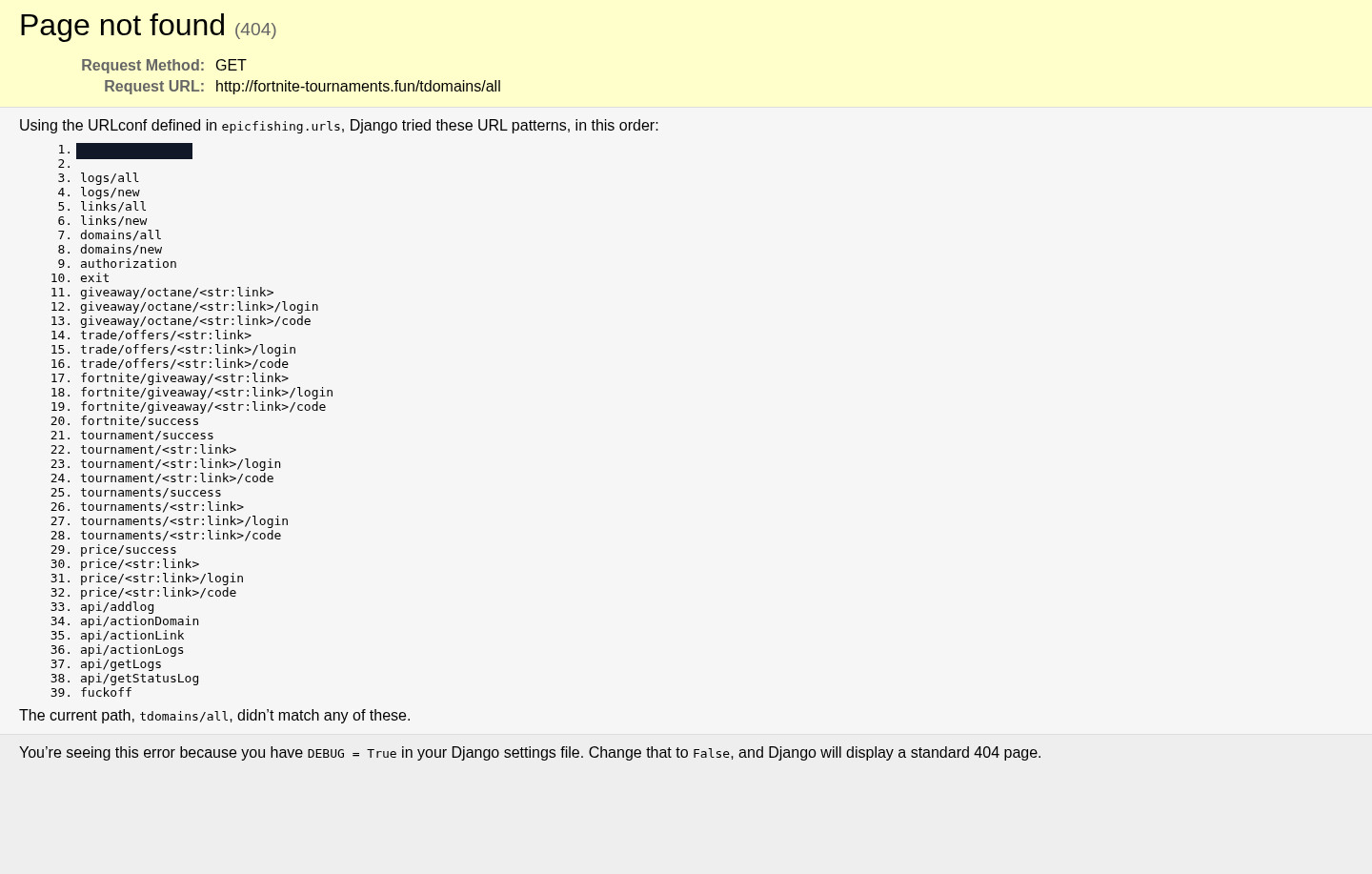
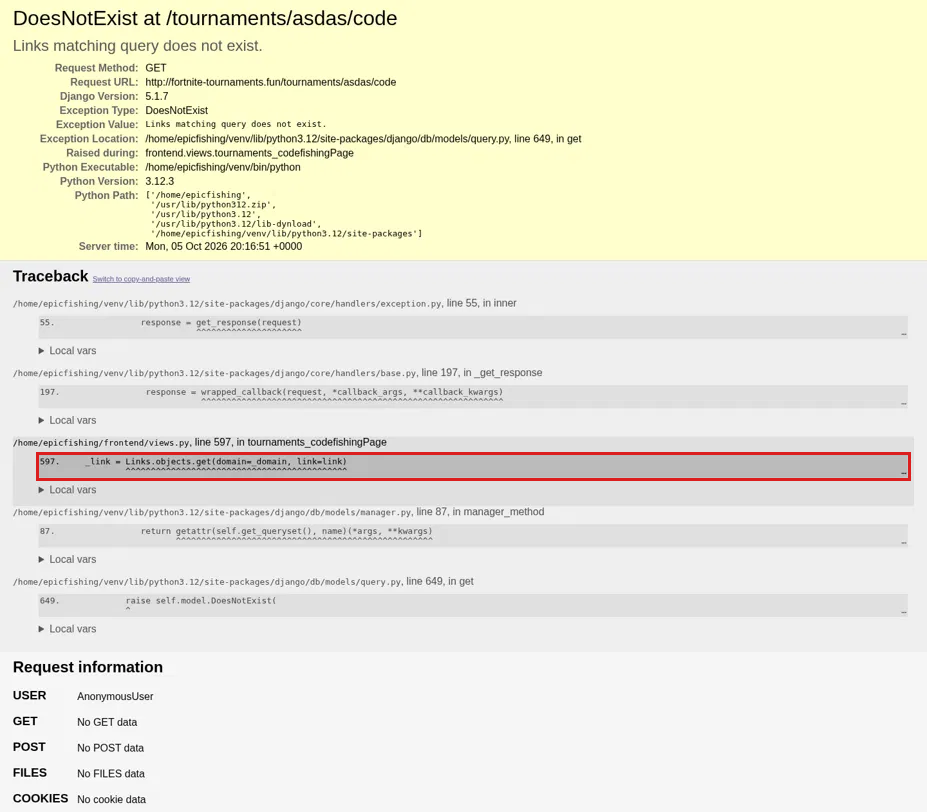
Why would a scam site show this? Two things went wrong at once. First, the kit looks up every link name in its database, and this particular request asked for one that doesn’t exist. The code had no plan for that, so instead of simply showing a blank page, it crashed. Second, the server was in debug mode; normally, a visitor would see “something went wrong”, but here, anyone who triggered the crash got the full report.
To read it, start with the yellow box, which states what failed. “Links matching query does not exist” means that no link has that name. The gray Traceback lists the steps the code took, and the red box marks the step that failed: the database lookup. The block at the bottom shows that this request carried no form data and no cookies, so the page itself exposes no one’s entries.
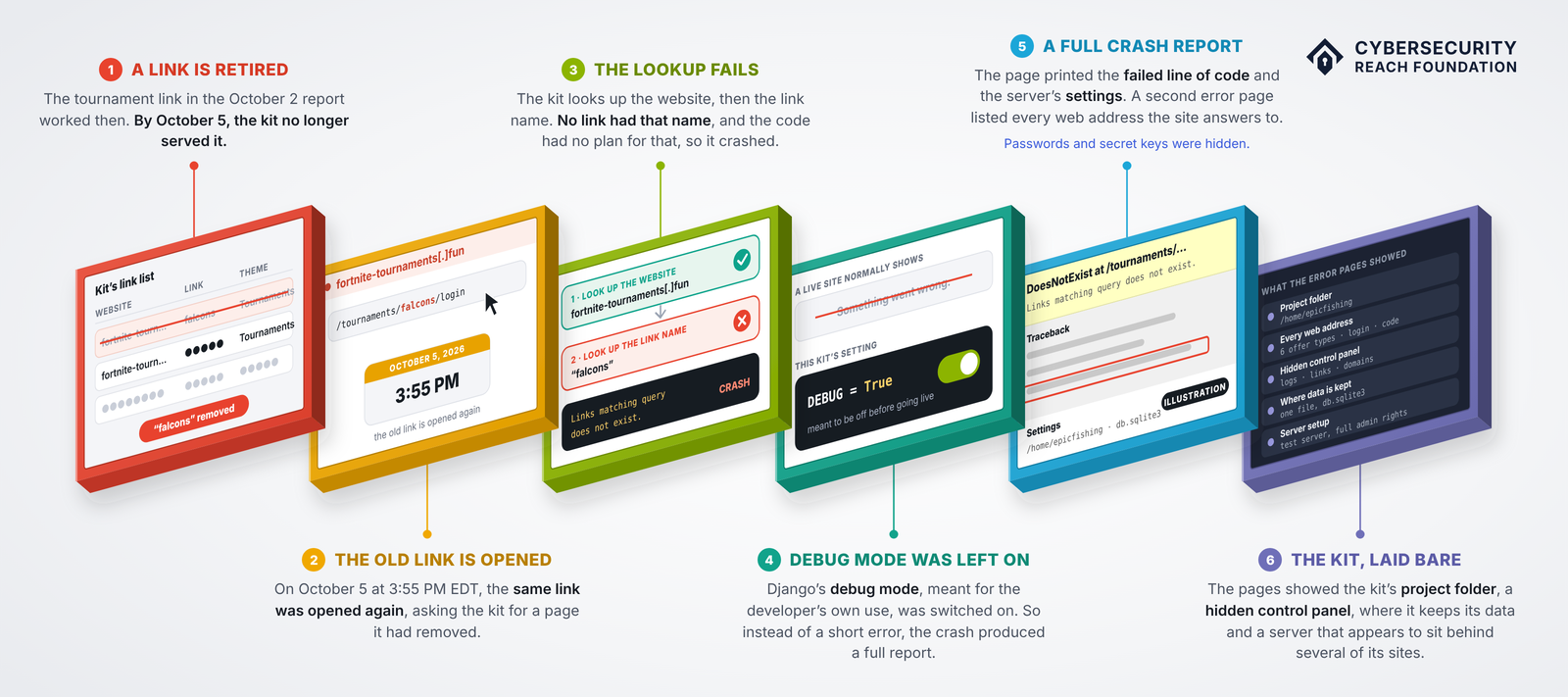
The Exposed Project and Configuration
The crash report named the kit’s project folder, /home/epicfishing. Further down the page, which the figure above doesn’t show, it printed the kit’s settings. In plain terms, they show that the kit:
- runs in debug mode, the setting that caused the leak
- answers to any website name, which lets one server stand behind many domains
- accepts requests from any other website
- keeps its data in a single file,
db.sqlite3, in its project folder - names a country-lookup file
- runs with full administrator rights on Django’s built-in test server
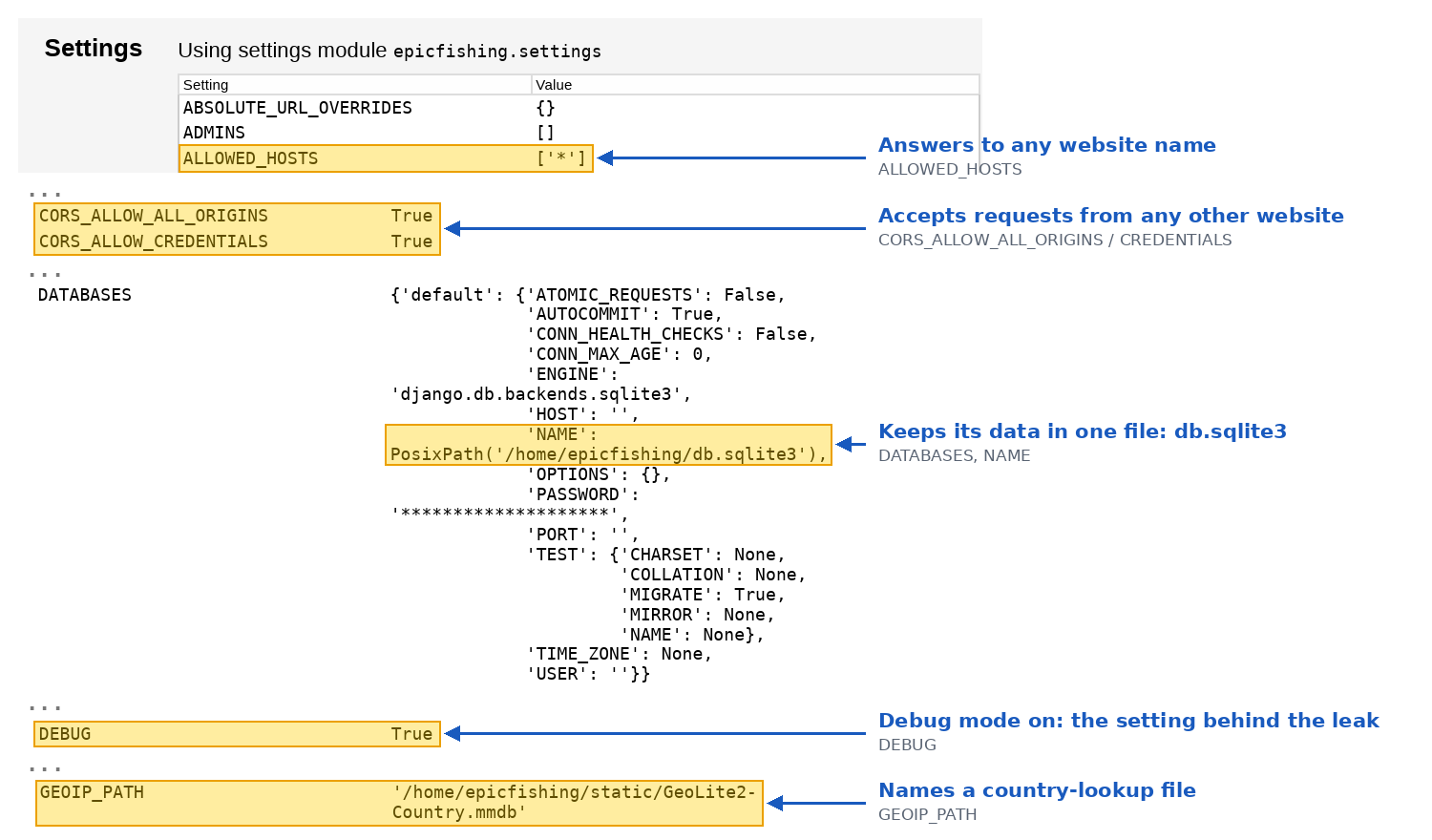
None of this is too sophisticated. There’s a common framework, one database file, and a test server. That is cheap to run and quick to move, which fits a kit that appears on several domains. The kit’s folder, settings and operator login page all use the name EpicFishing. Because the name matches no known kit family and searches for it found no public reports, we can infer that it may be a custom or privately shared kit, or simply be undocumented.
The route list at the top of this section (highlighted in blue) also shows a control panel: pages for “logs”, “links” and “domains”, plus background functions that add and read logs and switch domains and links on or off. Its login page (below) is marked as Russian-language and titled EpicFishing in the page’s title tag, though the screen shows only “Authorization”. A line of English text says login details are “issued by the main and administrators”. We viewed the page as an ordinary visitor and did not attempt to sign in.
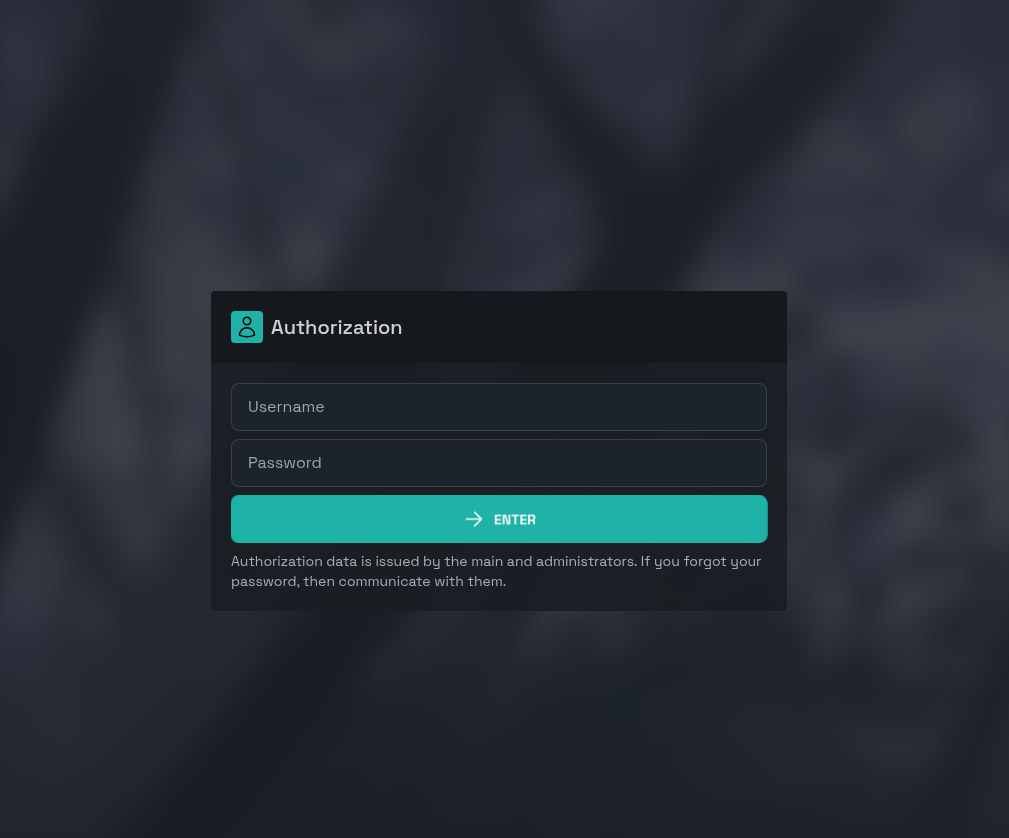
In phishing kits, “logs” usually means captured victim data, but what these logs hold, or whether any exist, is unknown. The line about “the main and administrators” suggests more than one person can use the panel.
Link Tracking and Theme Selection
Each lure link is a row in the kit’s database: a website, a link name and a theme. The code printed in the first October 5 crash report shows what the kit does for every visit:
- It reads the website name from the request and looks it up in its own table.
- It looks up the link name for that website.
- It adds one to the link’s visit count.
- It checks the link’s theme, the label for the type of lure it belongs to. This page only accepts “Tournaments” links, and any other link gets a “page not found” message.
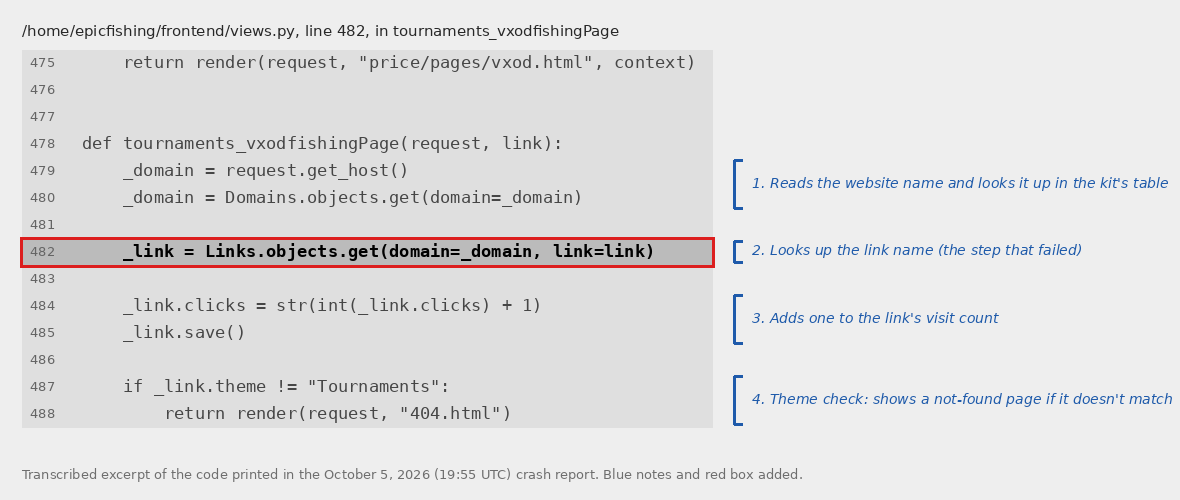
The “falcons” link worked on October 2, when it was reported. By October 5 the kit no longer served it for fortnite-tournaments[.]fun, so anyone who opened it received an error page instead of the fake sign-in one. That suggests an operator who creates, tracks and retires links.
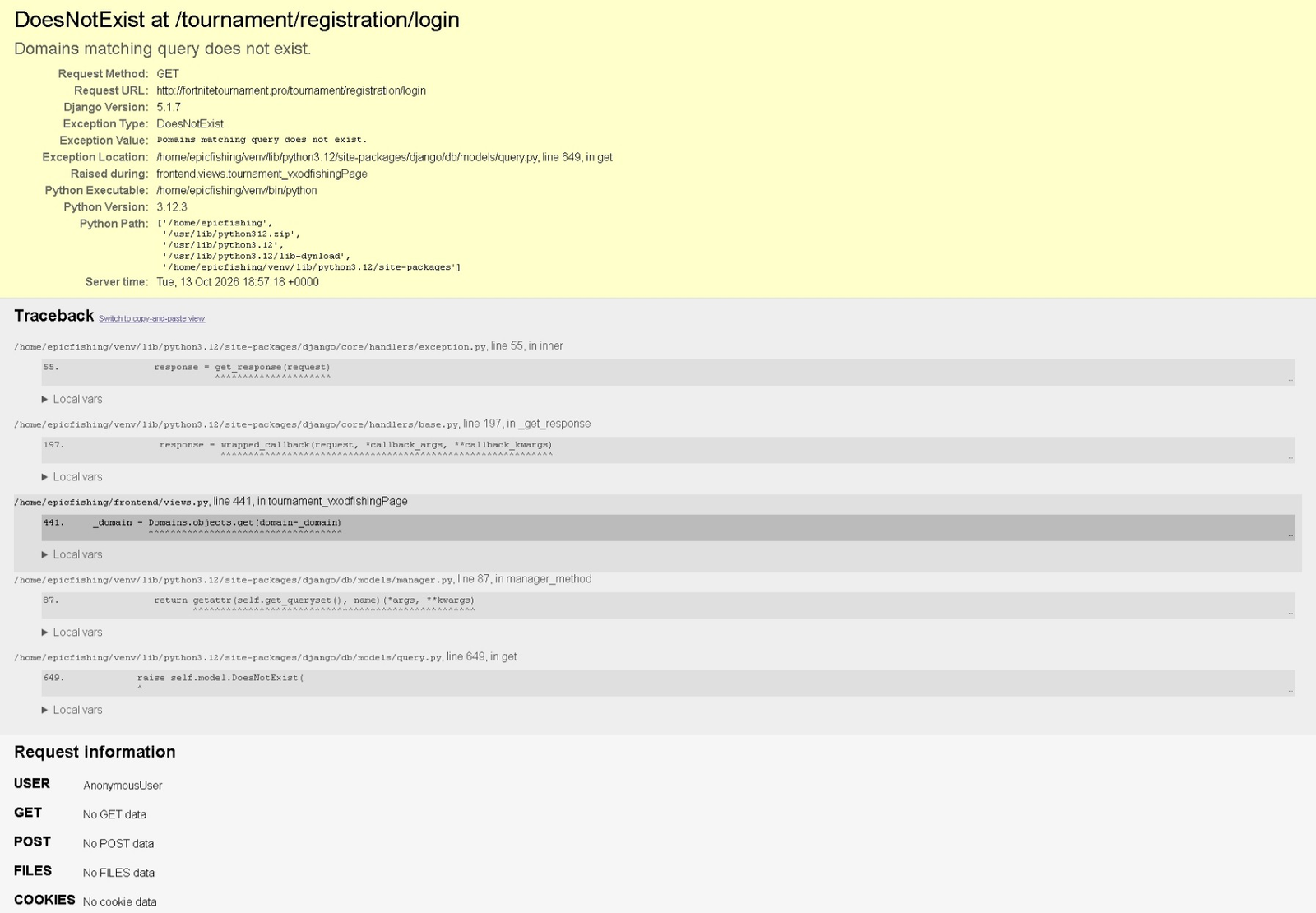
The kit also serves only websites in its own table, and a domain that isn’t listed gets an error instead of the scam page. That matters because it would allow an operator to switch a scam off on one domain without taking the entire site down. On October 13, a sign-in address on fortnitetournament[.]pro answered “Domains matching query does not exist” (below), which suggests the site hadn’t been set up in the panel at that time. On November 9, the home pages of both clone sites returned the same kind of error instead of the fake Epic page, which is consistent with the kit no longer recognizing those domains. The cause can’t be confirmed.
The kit also may also screen who sees its pages. Its settings point to a country-lookup file (software that matches an internet address to a country), and Cloudflare’s bot detection, a service that identifies automated visitors, showed up on the clone pages; we never saw the code that would use either. Phishing kits commonly hide from automated visitors such as search-engine crawlers and security scanners, so their pages don’t get indexed or flagged, and that may be the purpose here, but we couldn’t confirm it. One address in the route list has a vulgar name (shown with letters hidden in the appendix) and may be where unwanted visitors are sent. We saw the address but not what it does.
Repeated Login and Code Routes
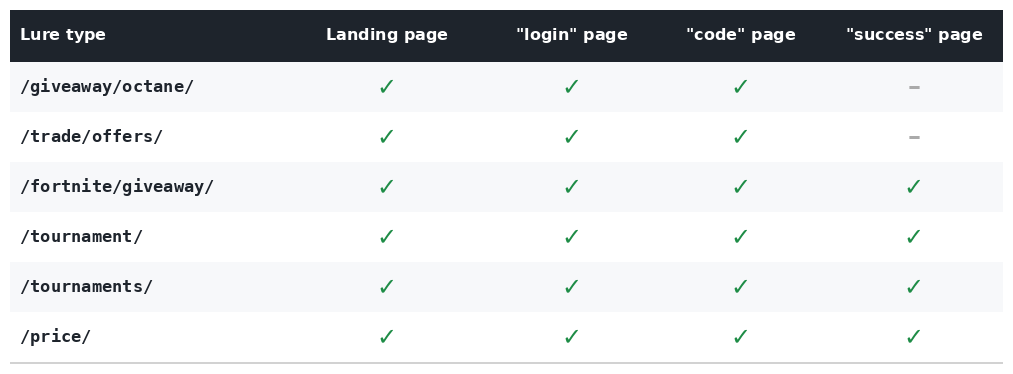
The route list shows six lure types. Each has a landing page, a “login” page and a “code” page, and four of the six also have a “success” page.
The sign-in step of one of them is below. It copies Epic’s sign-in screen, with options for PlayStation, Xbox, Nintendo and email.
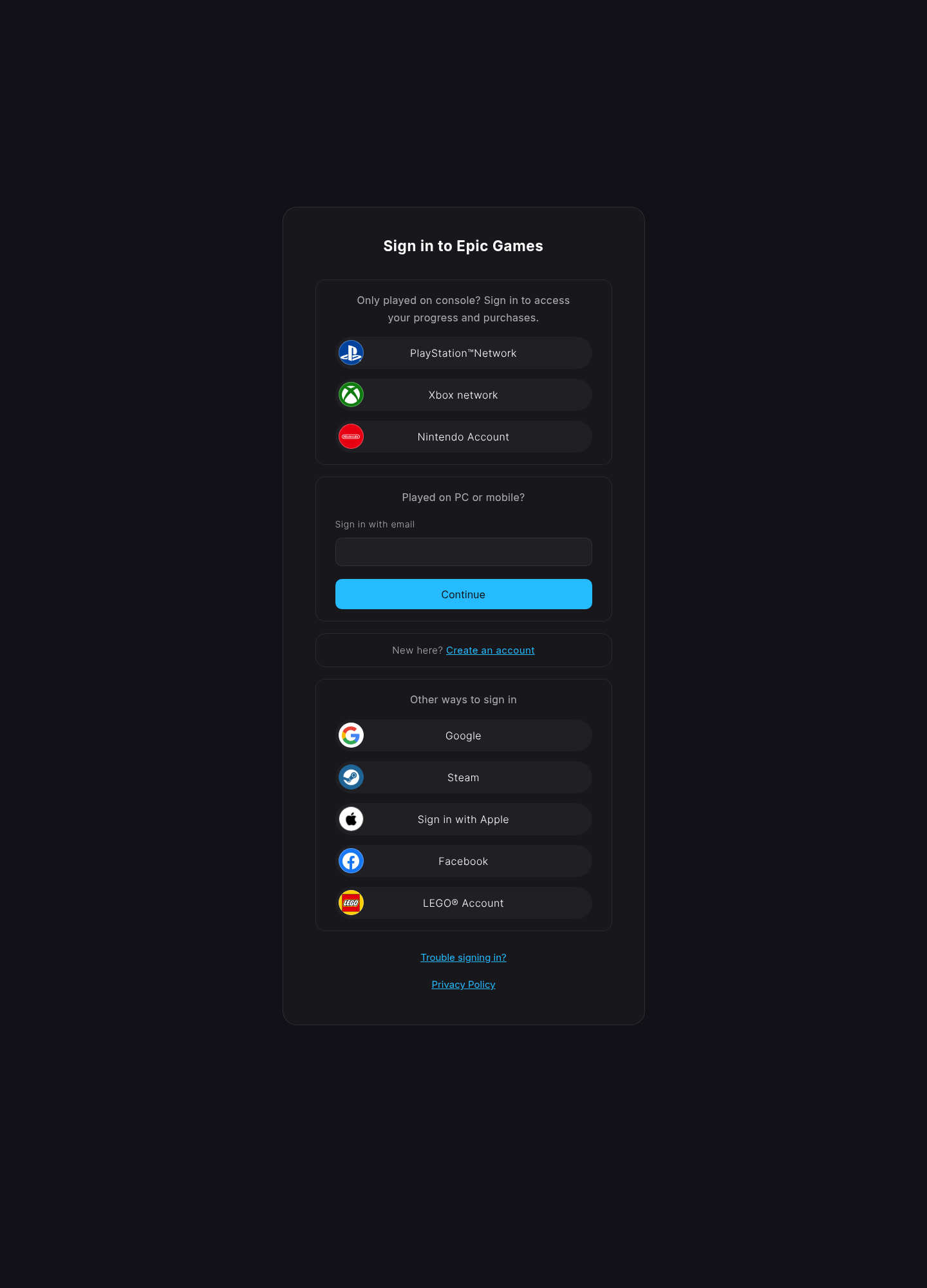
After the sign-in page, the route list shows a “code” page, probably meant to collect a verification code, and, in four of the six lure types, a “success” page, probably what the victim likely sees afterward. We never saw either page; the reported link had been retired, and we did not submit any forms or guess any link names. Epic says two-factor sign-in is required to take part in Fortnite competitive events, so a code prompt on a “tournament” page would not seem odd to a player.
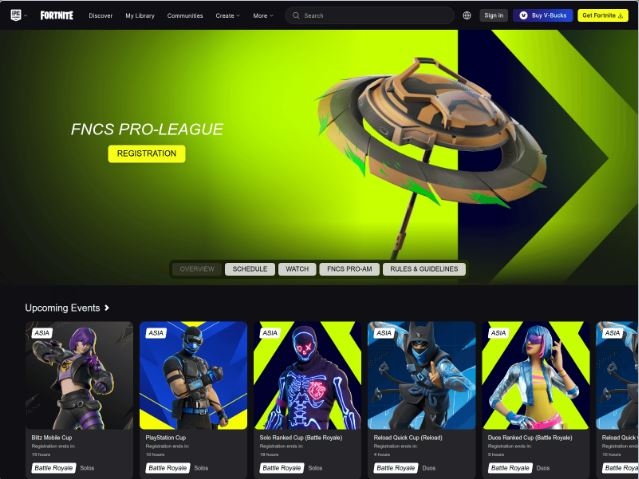
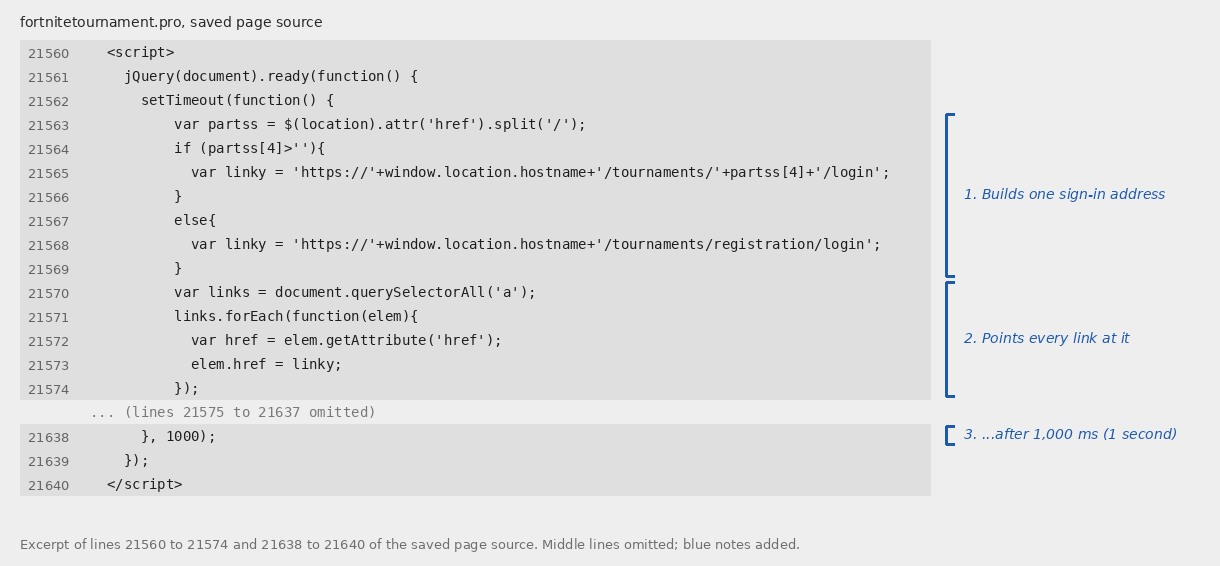
The two clone sites, garikfortnite[.]shop and fortnitetournament[.]pro, served the same copy of Epic’s Competitive page as of October 20 and 23 (garikfortnite[.]shop’s version is shown below). The saved page source of fortnitetournament[.]pro shows how the copy is set up: a script waits one second after the page loads and then points every link on it, including the menu and footer links, at the same fake sign-in address. In other words, whatever a visitor clicks, the next screen is meant to be the sign-in page. When we clicked through both sites on October 13, the buttons led to error pages (and once to the real Epic site) instead, which fits the sites not being set up in the kit at that time. We saw the script in source saved on October 23, so we can’t say whether it was already in place on October 13.
How the Sites Connect
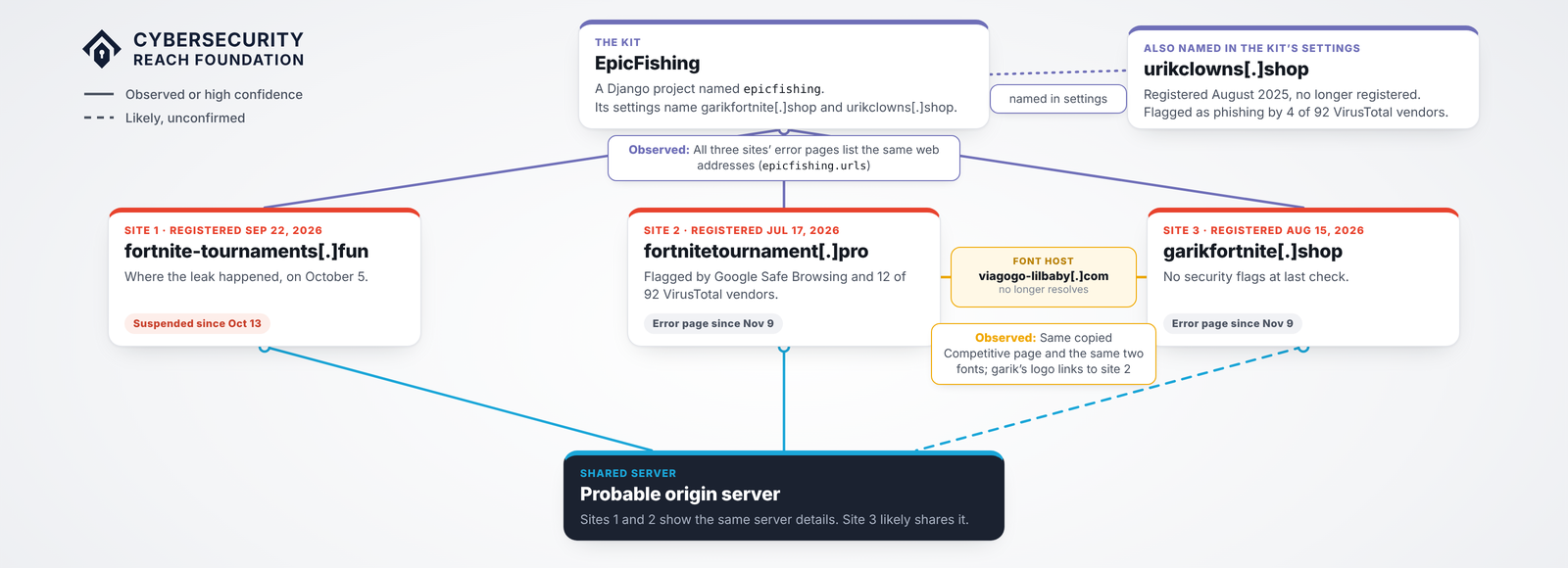
Three sites match the same kit: fortnite-tournaments[.]fun, garikfortnite[.]shop and fortnitetournament[.]pro. A fourth domain, urikclowns[.]shop, is named in the kit’s settings At least two of the three sites appear to share one server, but nothing in the records states who runs it, and we were unable to identify the person behind the scam.
Each site’s error pages list the same web addresses from the same project, epicfishing.urls: fortnite-tournaments[.]fun on October 5, and garikfortnite[.]shop and fortnitetournament[.]pro on October 13. That list belongs to the code running behind a site, so seeing it on all three shows they run the same kit.
Evidence of the Same Kit
As of October 20 and 23, garikfortnite[.]shop and fortnitetournament[.]pro served the same copy of Epic’s Competitive page, with the same page title. Both asked for the same two font files from viagogo-lilbaby[.]com, a domain that no longer resolves (below). That suggests the pages were copied from a common template. By November 9, both returned error pages instead.
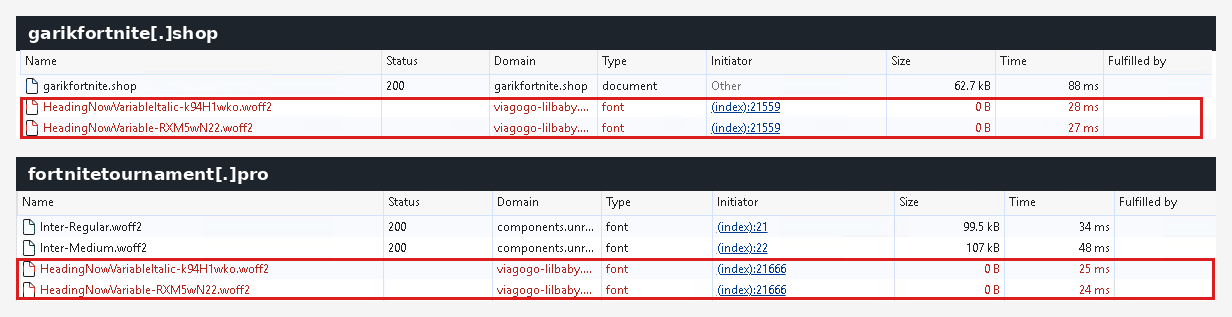
The kit’s own settings name garikfortnite[.]shop, and the Fortnite logo on garikfortnite[.]shop led to fortnitetournament[.]pro when clicked on October 13.
Evidence Suggesting Shared Infrastructure
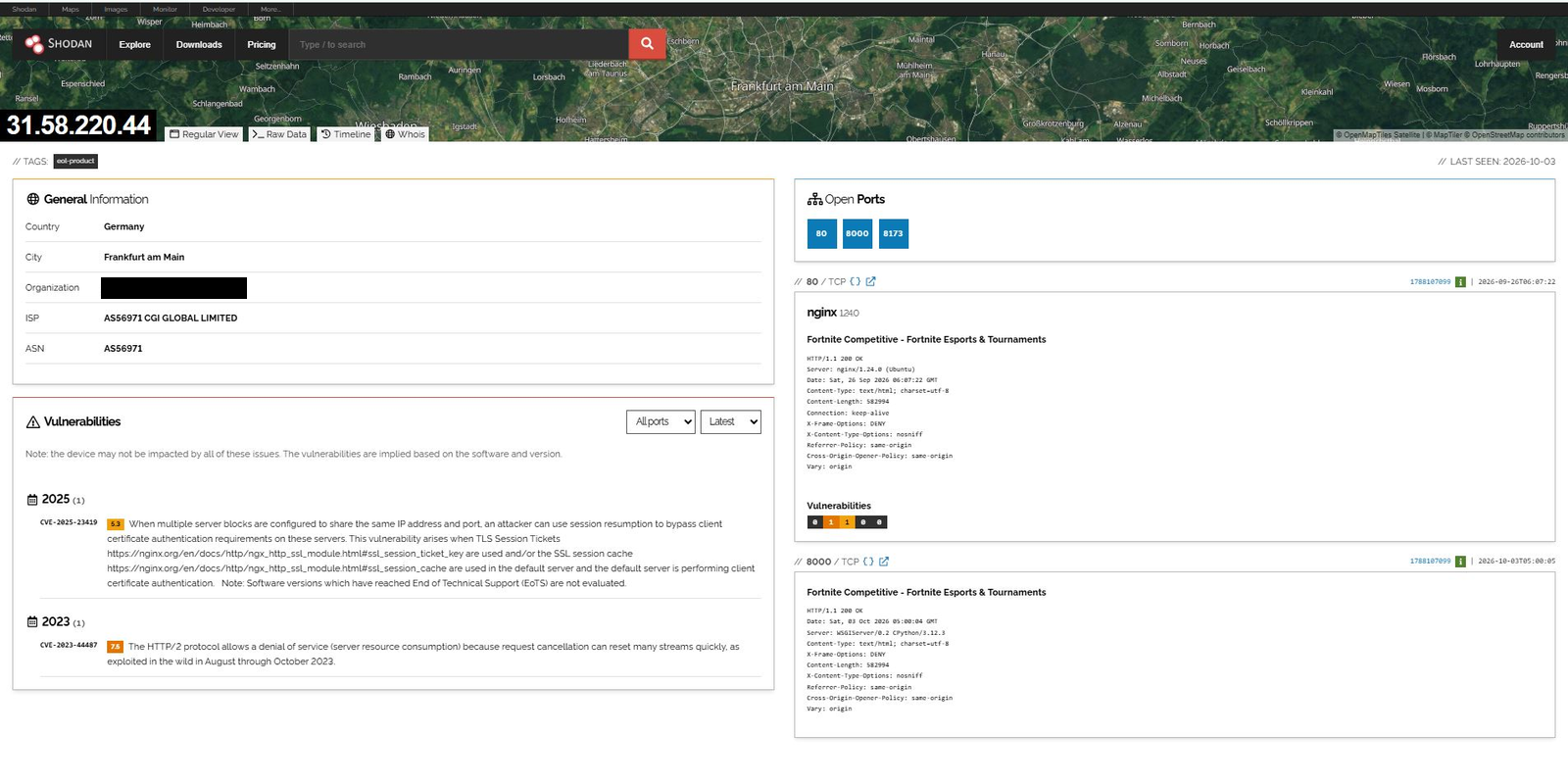
The error pages from fortnite-tournaments[.]fun (October 5) and fortnitetournament[.]pro (October 13) show the same connecting address, 31[.]58[.]220[.]44, the same server name, the same running-service ID (unchanged between those dates), the same project folder and the same software versions. That points to one server behind both sites, but we can’t confirm it.
A second match comes from Shodan (service that regularly scans the internet and records what it finds), which scanned that address on September 26 (port 80) and October 3 (port 8000) and recorded a Fortnite Competitive page of 582,994 bytes. A saved copy of fortnitetournament[.]pro’s home page is exactly that size. Shodan also lists a third open port, 8173, but its record shows no details for it.
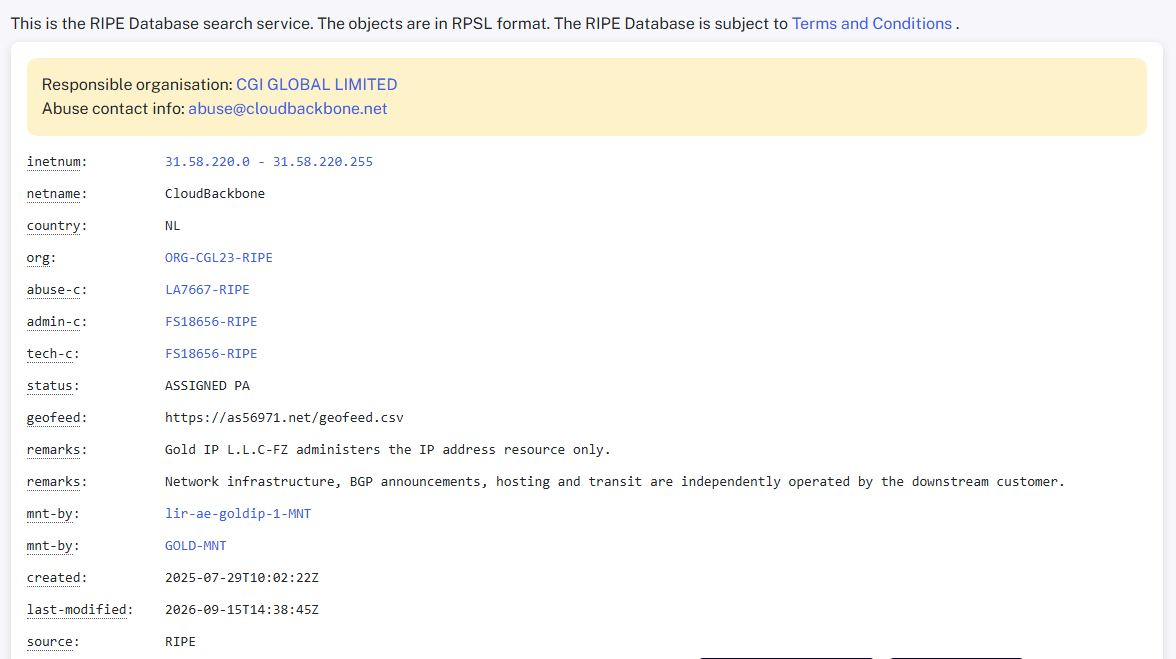
The address sits in a block named “CloudBackbone”, registered to CGI GLOBAL LIMITED. A remark in the record says another company only administers the address range, and that hosting and transit are “independently operated by the downstream customer.” That suggests the server is run by a customer of the network, not by the network itself.
The connection between garikfortnite[.]shop and the server is the least certain. All three sites sit behind Cloudflare, which hides each site’s real server address, and Cloudflare’s own addresses are shared by many unrelated sites, so they can’t show whether these sites share a server. The error pages from the other two sites exposed the server address. garikfortnite[.]shop’s error pages show the same route list but not the server address, so it may share that server, but we can’t confirm it.
Why Those Links Don’t Identify the Operator
Shared code and a shared server show that these sites belong together. But, they don’t show who runs them.
The registrations don’t connect them either. All three domains are at the same Russian registrar (REG.RU), but each uses different name servers and different contact details; the contacts are redacted or behind a privacy service. A server run by a customer of a network points to an account, not a person. A kit can also be used by more than one person; the operator login page says its credentials are issued by “the main and administrators”.
There are a few small clues that fit a Russian-speaking developer. The operator login page is marked Russian, the login pages are named “vxod” (Russian for “login”, written in Latin letters), the registrar is Russian, and two registration records list Russia as the registrant country. None of these identifies anyone. REG.RU sells worldwide, and the country field is self-reported.
Because urikclowns[.]shop was registered about 11 months before the earliest of the other three sites, and the kit’s settings name it, the kit or an earlier version of it appears to have been used on other domains before this campaign. An October 8 registry lookup listed it as created on August 8, 2025; by November 9 it was no longer registered, and VirusTotal flags it as phishing (4 of 92 vendors). The settings also leave out two of the three sites above. Since the kit accepts cross-site requests from anywhere, those lists are probably leftovers, so the kit likely runs on more domains than we found.
The three sites and the domain named in the settings had these statuses when last checked.
Site status (as of November 9, 2026)
| Site | Registered | Status (NOV 9) |
|---|---|---|
| fortnite-tournaments[.]fun | Sep 22, 2026 | On registrar hold since Oct 13 |
| garikfortnite[.]shop | Aug 15, 2026 | Resolves, but the home page now returns an error page; no flags at last check |
| fortnitetournament[.]pro | Jul 17, 2026 | Resolves, but the home page now returns an error page; flagged by Google Safe Browsing and 12 of 92 VirusTotal vendors |
| urikclowns[.]shop | Aug 8, 2025 | No longer registered; flagged by 4 of 92 VirusTotal vendors |
What Remains Unconfirmed
The error pages show how the kit is built, not what it did. These points remain open.
- Where submitted credentials went. The settings point to a database file on the server and show no setting that sends data elsewhere; secrets are hidden in this display, so forwarding can’t be ruled out.
- Why the two remaining sites now return error pages, and whether the operator removed them from the kit on purpose.
- How the links spread and whether accounts were compromised. The report didn’t record how people were reached. The kit counts visits, but we never saw the counts, and no victim data appeared on any page.
- Who runs the kit. The registrations are redacted or behind a privacy service, and the Russian-language clues are weak.
- Whether garikfortnite[.]shop shares the server. Its pages don’t show the connecting address.
- How old fortnitetournament[.]pro is. The registry lists it as created July 17, 2026, but urlscan says “2 years old” and VirusTotal about a year. Age matters because scam domains are usually registered shortly before use. An older domain could mean the operation has run longer than the registration suggests, or that an earlier owner let the name lapse before the operator took it. The registry record was also updated on August 11, and what changed is unknown. We could not tell which explanation applies.
How We Know
The findings rest on preserved copies, public records and ordinary visitor browsing. The original report, captures of the error pages, screenshots and public lookups were saved to a case board with about 43 distinct files, each with a hash. Public records included registry lookups, the network registry (RIPE), Shodan, urlscan.io and VirusTotal. On October 13 and 23, we also browsed pages from an investigation machine as an ordinary visitor, with browser tools used to read what loaded. Our requests were ordinary page loads and clicks on the clone sites’ menu buttons (for example “News,” “Download” and “My Library”), the operator’s login page, other pages named on the leaked route list, and two made-up addresses used to capture error pages.
Practical Guidance
Recognizing the Fake
- Check the address before signing in. Epic Games advises never logging into external sites with Epic credentials, and real offers appear on the Epic Games Store or official Epic Games websites and social media channels. The fake pages here used addresses like fortnite-tournaments[.]fun, fortnitetournament[.]pro and garikfortnite[.]shop.
- Be wary of unexpected offers. A tournament sign-up, giveaway or trade offer that arrives in a message or post, especially from someone you don’t know, and asks for your Epic login is the pattern this kit was built around. Epic also warns about suspicious offers such as free titles or V-Bucks.
- A code request doesn’t make a page real. Epic says two-factor sign-in is required for products including Fortnite tournaments, so a code prompt looks normal. It is the address, not the prompt, that shows whether the page is Epic’s.
- Notice links that all lead to the same place. On fortnitetournament[.]pro, a script sent every link, including the menu and footer, to one sign-in address. If clicking anything leads to a sign-in page, leave.
What to Do After Entering a Password or Code
- Secure your email email address first. Change its password as soon as possible.
- Change the Epic password, typing Epic’s address yourself, and change it anywhere else where the same password is used.
- Turn on two-factor sign-in, or check that it’s still on, using Epic’s help article (https://www.epicgames.com/help/en-US/fortnite-c75/epic-accounts-c114/2fa-a3218)
- Check the account. Look at the email address, linked console accounts, payment methods and purchase history for anything unfamiliar, and contact Epic support if something has changed.
- Parents: talk with children about tournament and giveaway links, and ask them to show you before they sign in anywhere from a link.
Which Indicators Are Useful to Defenders
Indicators are traces a kit leaves behind that help others recognize it. Defenders, such as IT and security staff, web-filter and email-security providers, as well as abuse teams at registrars, hosts and Epic, can use them to block known domains and addresses, search logs for visits and find other sites built from the same kit.
The indicators below are ranked by how long they are likely to stay useful, since the operator can change some of them easily.
- Most durable: the three domains, urikclowns[.]shop and the address 31[.]58[.]220[.]44 (the probable origin server, shared by two of the sites). The project name
epicfishing.urlsin the kit’s error pages is specific to this kit. The messages “Links matching query does not exist” and “Domains matching query does not exist” appear on any site built the same way, so use them with the project name. - Moderately durable: the page title “Fortnite Competitive - Fortnite Esports & Tournaments” on a non-Epic domain, the script that rewrites every link to a sign-in address, and the two font requests to viagogo-lilbaby[.]com. These match captures from October 20 and 23. By November 9 both clone sites returned error pages, so they help find earlier copies or new ones from the same template.
- Short-lived: the page size of 582,994 bytes, which the operator can change. Don’t use Cloudflare addresses, because many unrelated sites share them.
Stay passive. Use stored scans, and don’t try the operator’s panel or API routes, submit forms or guess link names.
Tell us. If this template turns up on other domains, let us know at info@cybersecurityreach.org or https://cybersecurityreach.org/check.
About CSRF
The Cybersecurity Reach Foundation is a volunteer-run 501(c)(3) nonprofit bringing cybersecurity and scam awareness to everyday people. Check anything suspicious with our free Scam Checker, report scams to ScamArchive, get alerts from WatchOut, and reach our researchers at info@cybersecurityreach.org. Support our work.
Domains and addresses in this report are defanged (for example, example[.]com) so they can’t be opened by accident. Please don’t visit them. Findings reflect what we could see on the dates given in the report.
Technical Appendix
- Software: Django 5.1.7, Python 3.12.3, SQLite database in the project folder, run as root on Django’s built-in server (
WSGIServer/0.2), behind Cloudflare. Debug mode on, allowed hosts set to a wildcard, and cross-site requests allowed from any origin with credentials. - Server: connecting address 31[.]58[.]220[.]44 (Frankfurt per Shodan); block 31[.]58[.]220[.]0/24, AS56971; hostname
server-ks8cpz[.]novalocal(it looks like a default cloud-instance name, which is consistent with a rented virtual server). Shodan saw nginx 1.24.0 on port 80 and the Django server on port 8000, both serving the same 582,994-byte page. The abuse contact is abuse@cloudbackbone.net. - Routes (hidden path withheld): an operator login page; logs, links and domains pages; background functions for adding and reading logs and for acting on domains, links and logs; and the six lure families with sign-in and code steps. The route with the vulgar name is spelled “f*ckoff”.
- Code names: login pages are named
*_vxodfishingPageand code pages*_codefishingPage. - Settings lists: the cross-origin and trusted-origin lists name fortnite.com, garikfortnite[.]shop and urikclowns[.]shop. They were identical on October 5 and 13 and omit the other two sites. With cross-origin requests allowed from anywhere, they are probably leftovers.
- Registration: all three domains are at REG.RU on different Cloudflare name-server pairs. The record for fortnite-tournaments[.]fun was updated October 13 at 09:22 UTC with a registrar hold, which was still in place on November 9.
- Evidence: hashes are in the case record. Our saved copy of the fortnitetournament[.]pro page is
6229cfe1257f0c55ca8ed31987fc342976a37c1e8d47e30453d473e1422096a7.
Indicators
- domain: fortnite-tournaments[.]fun (suspended)
- domain: garikfortnite[.]shop (resolves; error page as of November 9)
- domain: fortnitetournament[.]pro (resolves; error page as of November 9; flagged)
- domain: urikclowns[.]shop (no longer registered; flagged by 4 of 92 VirusTotal vendors)
- domain: viagogo-lilbaby[.]com (font host, doesn’t resolve)
- ip: 31[.]58[.]220[.]44 (probable origin server)
- other:
HeadingNowVariable-RXM5wN22.woff2andHeadingNowVariableItalic-k94H1wko.woff2requested from viagogo-lilbaby[.]com (seen October 23; the clone pages no longer serve them as of November 9) - other: page size 582,994 bytes (fragile, since the operator can change the page; the clone pages returned error pages on November 9)
Stay Protected
Use our free tools to protect yourself from the threats discussed in this investigation.