

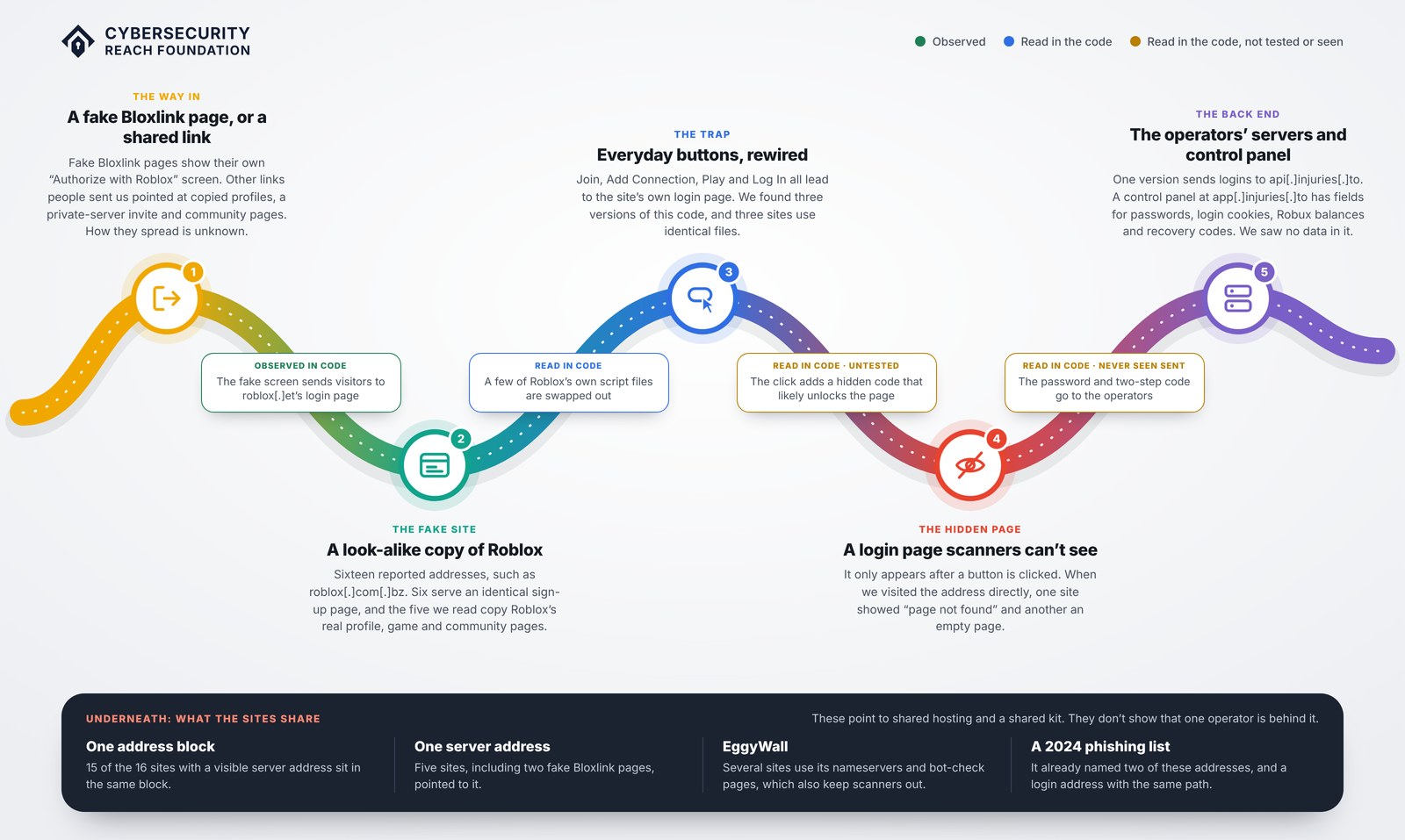
Malicious actors are targeting Roblox players with fake Roblox and Bloxlink pages. Public reporting has shown the scam from the victim’s side. We looked at the other side: what a ready-made phishing kit looks like once deployed, and how it hides from security tools. The sites we examined appear to share a kit and hosting, and they are built to look familiar to players.
What We Investigated
What We Already Knew
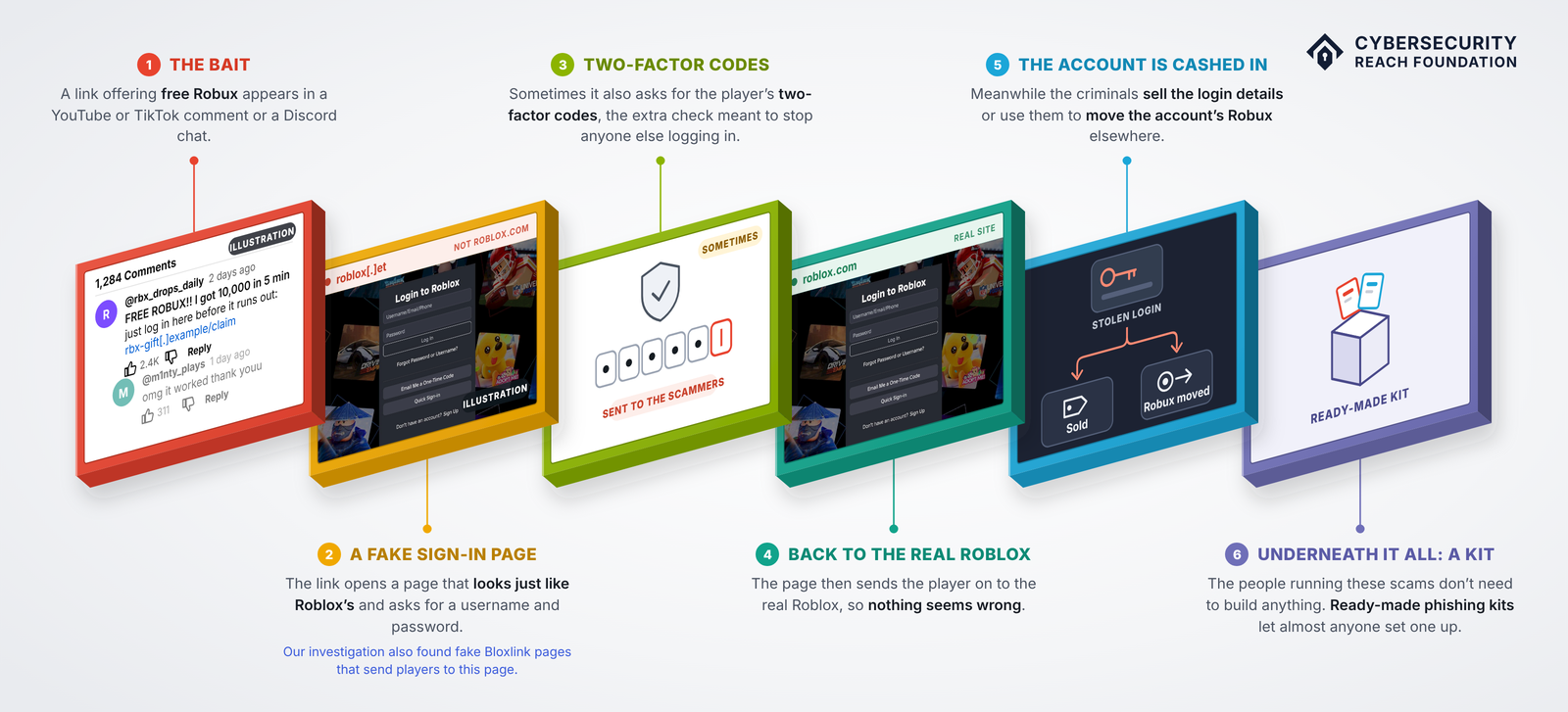
In September 2026, The Guardian reported on a scam aimed at Roblox players, many of them children, drawing on research by the cybersecurity company NordVPN. The exposé revealed what the scam looked like from the victim's perspective: they are lured to sign-in using an unofficial link with the promise of free Robux; the fake sign-in steals their information and then redirects them to the real Roblox site. A player is offered free Robux through a link in a YouTube or TikTok comment or a Discord chat. The link opens a sign-in page that looks just like Roblox’s and asks for a username, a password and sometimes the player’s two-factor codes. The page then sends the player on to the real Roblox, so nothing seems wrong. Meanwhile the criminals sell the login details or use them to move the account’s Robux elsewhere. NordVPN also found that the people running these scams don’t need to build anything as ready-made phishing kits let almost anyone set one up.
The Reported Sites
We began our investigation after noticing a large number of similar Roblox-related reports sent to The Cybersecurity Reach Foundation (CSRF)’s free reporting tool, where members of the public submit a suspicious link to have it checked. We looked at those reports, along with registry records, certificate logs and DNS records. In the Roblox-related reports we reviewed, two patterns stood out:
- Look-alike copies of roblox.com on country-code addresses, such as roblox[.]com[.]bz: 92 reports about 16 addresses, between 1 August and 1 November 2026.
- Pages imitating Bloxlink, a Discord bot commonly used by Roblox players: 9 reports about 3 addresses in the same period.
Neither pattern is new. Certificate logs show roblox[.]com[.][cc] names in use as early as 2021, and a public phishing list from November 2024 already included two of these addresses. NordVPN has also reported look-alike addresses like these, along with fake pages imitating RoVer, a tool similar to Bloxlink. The Bloxlink clones in our data are recent, with first certificates issued between July and September 2026. We can’t say how common either pattern is among phishing overall, because our data only covers what is reported to us.
We can't know for certain why attackers use these patterns, but we suspect it may be for three reasons. First, these addresses keep “roblox.com” intact at the start, so a quick glance can miss the country code added at the end. Second, the method keeps working even when individual sites are taken down. When one address gets suspended, dropped or taken down, the same look-alike setup carries on under other addresses. Registry records suggest the names were dropped and registered again, and 4 of the 23 records we checked show a name suspended or inactive, yet the same approach continues under other names. Finally, for the Bloxlink clones, attackers can expect that players are used to verifying their Roblox account to join Discord communities, so a request to “authorize” with Roblox looks like a normal step.
Research Question
In this investigation, we asked: what do these fake sites have in common, and how do they stay hidden from security tools?
What We Found
How the Fake Pages Are Set Up
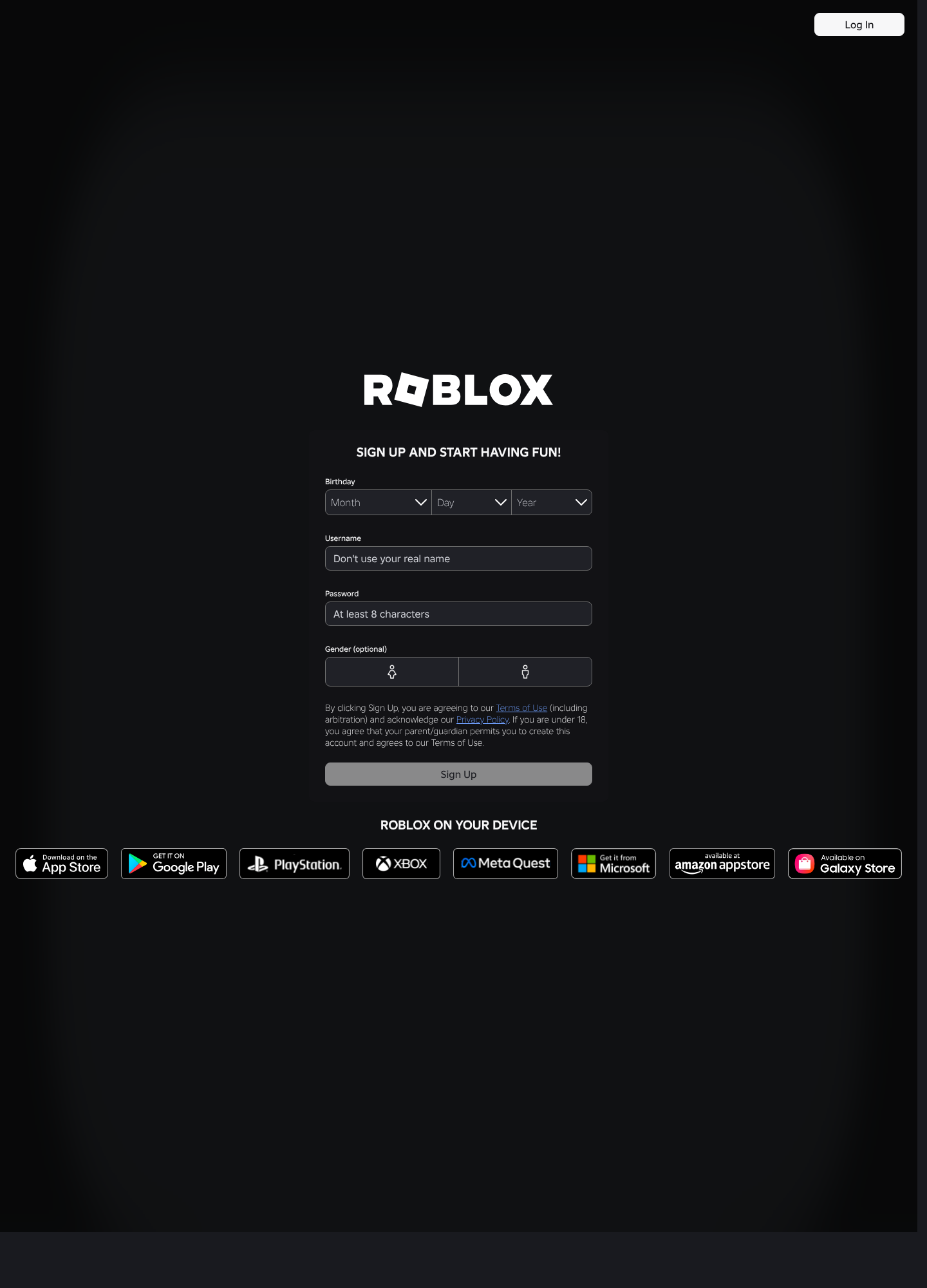
We captured the home page of 12 Roblox look-alike addresses. Six of them show a copy of Roblox’s sign-up page, with username and password fields, and all six are identical: their saved screenshots match byte-for-byte (they have the same digital fingerprint, called a SHA-256 hash). This is the page a visitor sees first; the login page is separate and stays hidden (see below). The other six didn’t show the fake page when we captured them. Two showed a “prove you’re human” check that blocked our capture tool, one had already been flagged as phishing by Cloudflare, one showed a maintenance message, one showed a “page not found” error styled to look like Roblox’s, and one gave a browser security warning. The Site Groups table in How the Evidence Fits Together lists each address.
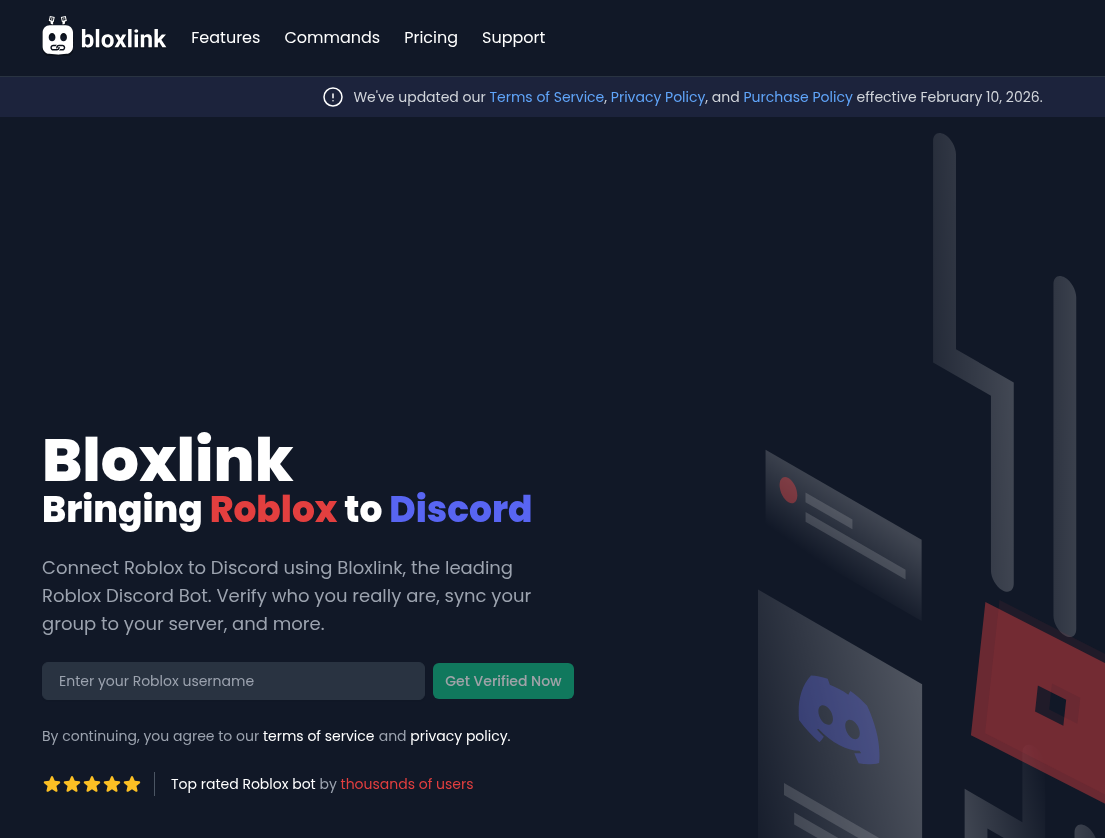
Bloxlink is a tool Discord server admins use to check who joins. To get into a server that uses it, a member verifies their Roblox account on the real Bloxlink site, blox.link. For many Roblox players, this is a routine step. The Bloxlink clones copy that site, in two builds. get-bloxlink[.]com and bloxlink[.]gr copy an earlier version of the real site’s code, with one change: the Get Verified button no longer starts Bloxlink’s verification. Instead it saves the Roblox username the visitor typed in their own browser and opens an embedded page.
bloxlink[.]pk and bloxlink[.]asia (and bloxlink[.]chat, which forwards to .pk) are a separate, static copy. On both builds the embedded page is a fake “Authorize with Roblox OAuth” screen. On get-bloxlink[.]com and bloxlink[.]gr, clicking Continue shows “Redirecting to roblox.com…”, but the page sends the visitor to the login page of roblox[.]et, one of the Roblox mirrors (copies of Roblox’s real site served under a look-alike address), with the typed username attached to the address. On the other two clones we couldn’t read where Continue leads, as their code is obfuscated, so it can’t be read as ordinary text.
Of the 16 look-alike addresses reported to us, we captured the home page of 12 and read the saved code of five: roblox[.]com[.]bz, roblox[.]ly, roblox[.]com[.]mu, roblox[.]et and robiox[.]com[.]py. All five serve copies of Roblox’s real profile, game and community pages. Each mirror replaces a few of Roblox’s own script files with versions that change the code behind ordinary buttons. Join, Add Connection, Play and the Log In link all lead to the mirror’s own login page instead. So a player who clicks the buttons they would normally use to join a game or add a friend is shown a login prompt, which looks natural because those actions need an account. They then reach a login page where a password is typed. It is hidden from anyone who visits its address directly, so these buttons are the only way to reach it.
What the buttons say vs. what they do
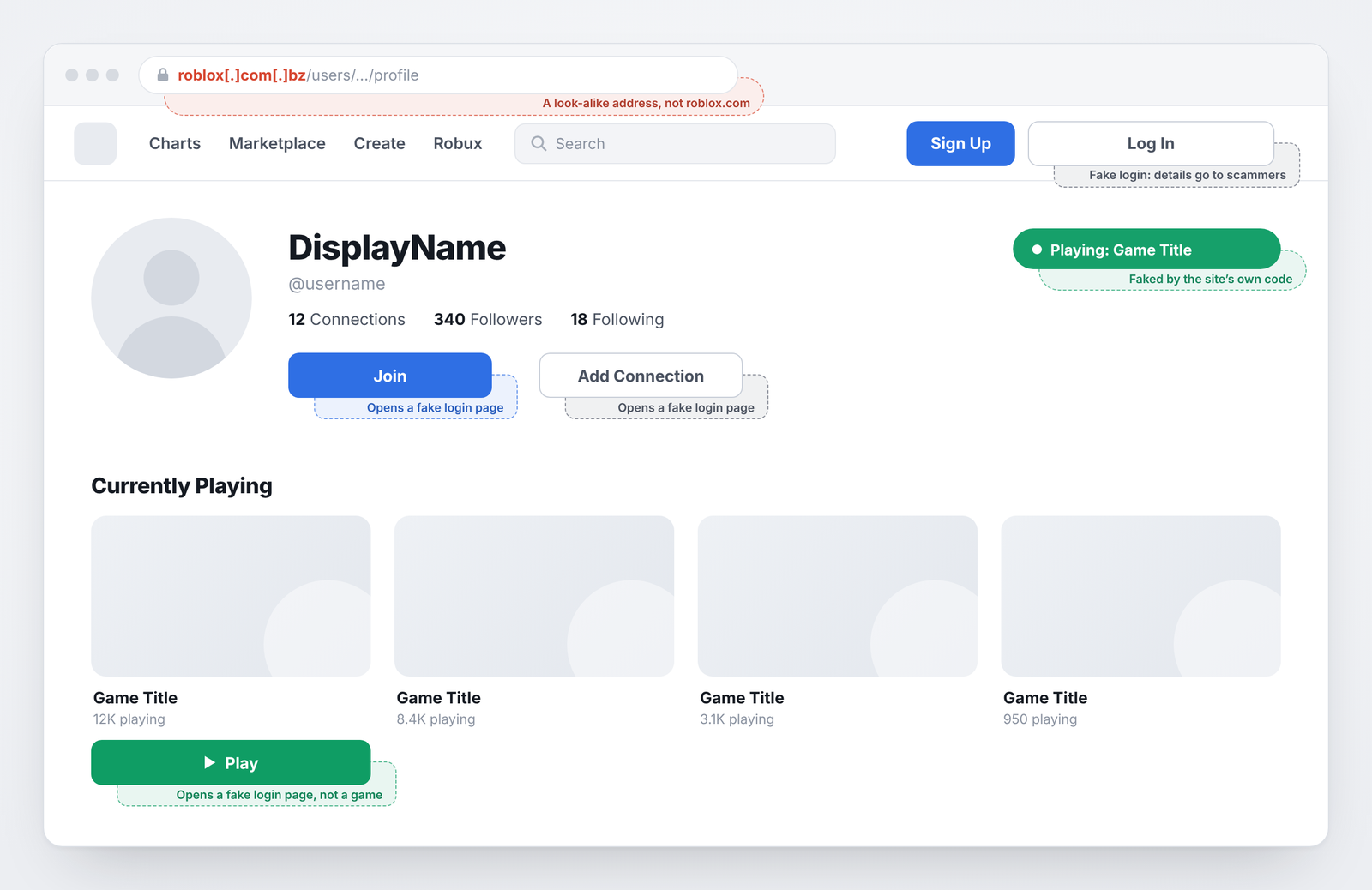
The login page is only shown to people who reach it by clicking a button on a mirrored page, such as Join. If someone types the login address straight into a browser, or a security scanner checks it, no login page appears. We saved copies of the login address on two mirrors: roblox[.]com[.]bz sent us to Roblox’s real “page not found” screen, and roblox[.]et returned an empty page. When a player clicks a button, the mirror’s script adds a hidden code to the request for the login page. We think that code is what tells the server to show the login page, but we did not test it. The likely purpose is to keep the login page out of view of scanners and researchers, so the site looks harmless to them. For the player who clicked through, nothing is hidden.
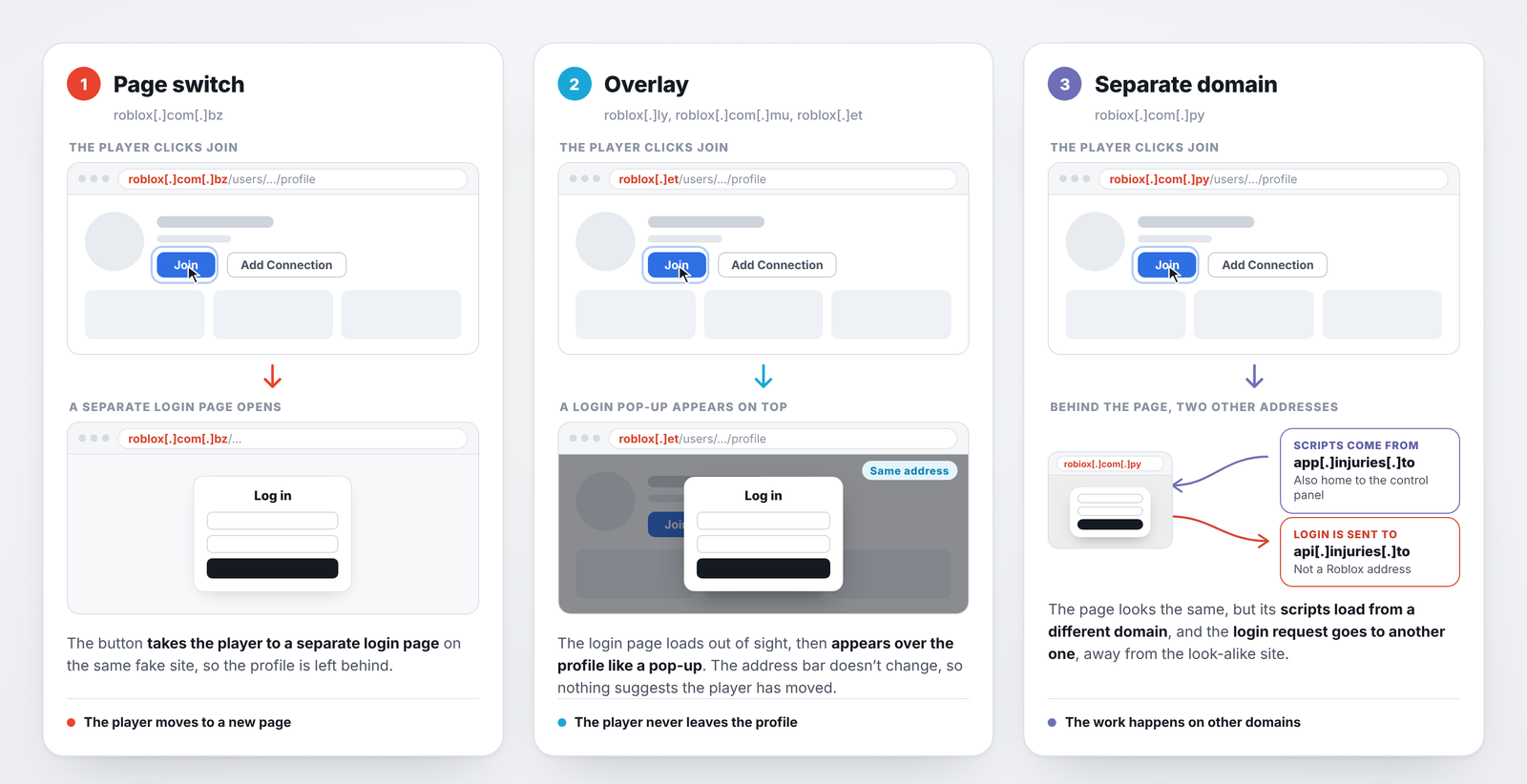
We found three versions of altered code across five mirrors. In the page-switch version (roblox[.]com[.]bz), the button takes the visitor to a separate login page. In the overlay version (roblox[.]ly, roblox[.]com[.]mu and roblox[.]et), the page loads the login page out of sight and then shows it on top of the profile, like a pop-up. The visitor never leaves the profile page, so the web address at the top of their browser does not change. It still shows the mirror’s own address, so nothing on screen suggests they have moved to a login page. In the separate-domain version (robiox[.]com[.]py), the scripts come from a different domain, app[.]injuries[.]to, and the login request goes to api[.]injuries[.]to.
The Hosting
Of the 16 sites we found with a visible server address, 15 sit in the same address block. An address block is a range of consecutive internet addresses, like houses on one street, that a hosting company rents out. Here it runs from 202[.]170[.]75[.]0 to 202[.]170[.]75[.]255. Sites in the same block share a host, but this doesn’t show they have the same operator.
Several sites use EggyWall’s nameservers and bot-check pages. Those bot checks also keep automated visitors out: several of our own captures got EggyWall’s page instead of the site. Sites often serve identical pages or files. The shared code goes beyond the sign-up page. roblox[.]ly, roblox[.]com[.]mu and roblox[.]et serve byte-identical copies of the same rewritten Roblox script files, and all three set a cookie with the same unusual name. robiox[.]com[.]py runs a different version, which loads its scripts from a separate domain, app[.]injuries[.]to.
Public certificate logs show some of these addresses were in use as early as 2021. But registry records show their current registrations began between September 2025 and August 2026, indicating the names were churned and then registered again. 4 out of the 23 registry records we checked showed the domain suspended or inactive, and 8 names no longer resolve. Some of these names were also known to security researchers before. A public list of phishing sites from November 2024 already included roblox[.]com[.]kz and roblox[.]et, along with a login address, api[.]wakura[.]lu/v3/authentication. The robiox[.]com[.]py version we read sends logins to api[.]injuries[.]to/v3/authentication. The domain is new, but the path is the same, which suggests the same kit has moved to a new backend.
These records point to shared hosting and a shared kit, but they aren’t enough to show that the same operator is responsible, or how exactly players reach these pages.
The Control Panel
The control panel is a login-only web app called “Pages”, at app[.]injuries[.]to. Visitors sign in with Discord or Telegram. We could not get past that sign-in, so we read the page code we had saved.
What we saw in the code: a record called “omniHits” with fields for a username, password, the cookie that keeps a Roblox player logged in, Robux balance and recovery codes. It also has settings for sending alerts to Discord, a “Form” builder for the fake profile pages (which would explain the fake “playing” status), and counters labelled Hits and Users.
Summary of the Control Panel's code
| In the panel’s code | What it likely holds | Why it matters |
|---|---|---|
| omniHits | One record per captured login | The panel appears built to store stolen accounts |
| Username and password | The player’s login details | Enough to sign in as them |
| Login cookie | What keeps a player signed in | Can let someone into the account without the password |
| Robux balance | How much Robux the account has | Shows which accounts are worth the most |
| Recovery codes | Backup codes for two-step verification | Can get around the extra login check |
| Discord alerts | Settings for sending notices to Discord | Operators can be told when a login comes in |
| Hits and Users counters | Running totals | Tracks how many logins it has collected |
From the field names, we can infer that the panel is built to collect and sort stolen Roblox logins. We never saw any data inside it. The panel’s own security certificate (the record that lets a site show the padlock in a browser) was issued for app[.]injuries[.]to. It also lists several look-alike addresses: roblox[.]com[.]am, roblox[.]com[.]ml, roblox[.]je and roblox[.]tc. That suggests the panel and those mirrors were set up together. The panel also appears to be built for multiple operators, not one.
We don’t know who uses the panel, or whether it has collected any logins.
How We Reviewed It
Sources we used
| Source | What it shows | What it can’t show |
|---|---|---|
| Web-check submissions in the CSRF Inbox | Which links people asked us to check, with a capture of each page | How they got the link, or how common it is |
| Our own page captures | What each site served on that date | What it served on other dates |
| Registry records | Creation dates, status, nameservers | Who controls the name |
| Certificate logs | Which names had certificates, and when | That a site was live |
| DNS via Cloudflare’s public resolver | Where names pointed on that date | Ownership, or the real host behind Cloudflare |
| CSRF zone data | When a name appeared in a zone, and its nameserver changes | Registration, activity, or country-code endings |
| Wayback Machine | Archived copies of EggyWall’s pages | Pages it didn’t archive |
| Public reporting (the Guardian, NordVPN) | What others observed | Anything we didn’t check ourselves |
How we handled the evidence
- Every finding is labelled as observed, a source claim, an inference or unknown, and tied to a dated capture or record. Public reporting is treated as a source claim, not as our own observation.
- “Identical” pages were matched by file fingerprint (SHA-256).
- Usernames and other personal details are left out or blurred.
How the Evidence Fits Together
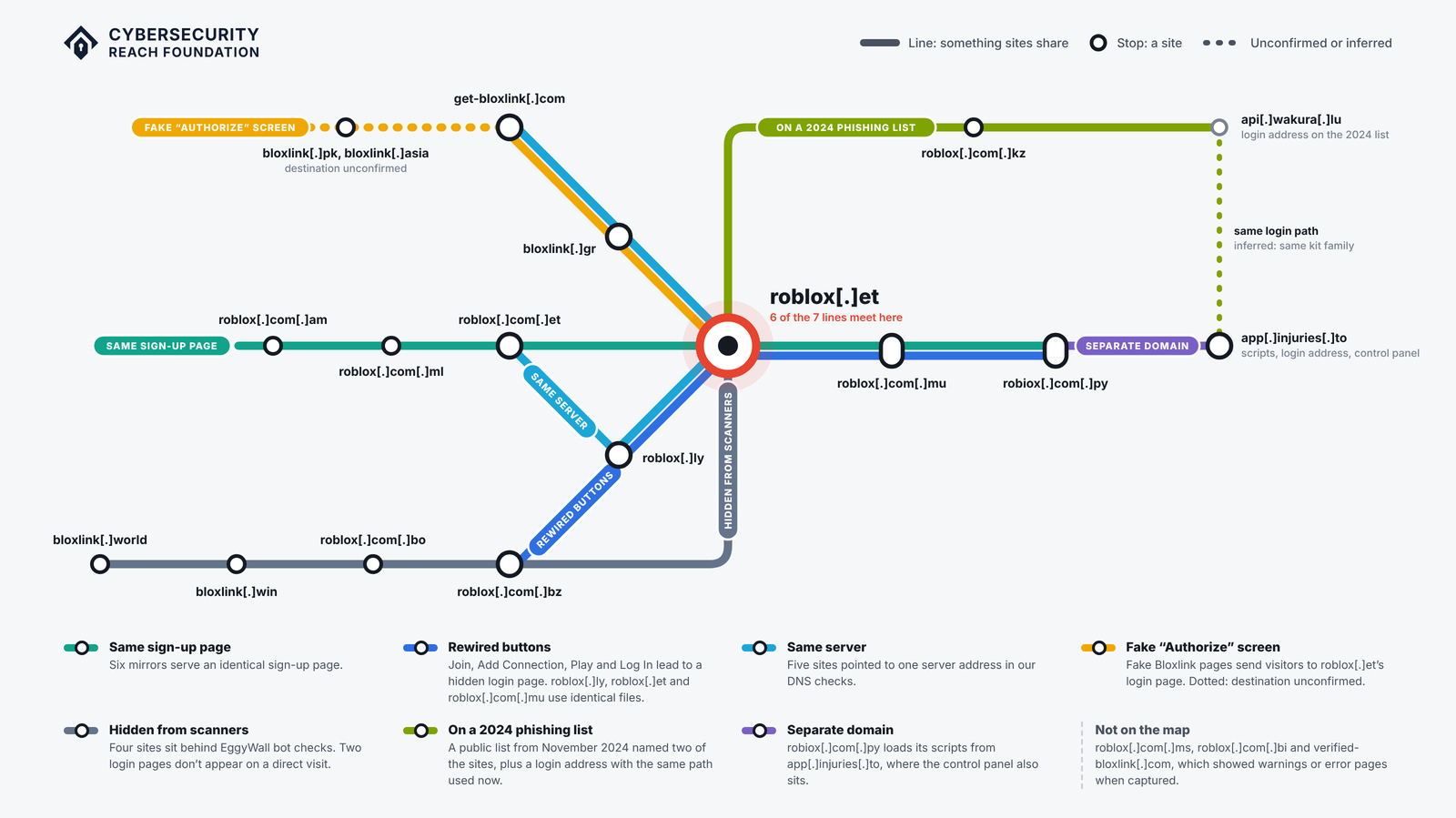
Site Groups
Site groups
| Group | Sites | What ties them |
|---|---|---|
| Sign-up mirrors | roblox[.]com[.]am, roblox[.]com[.]ml, roblox[.]com[.]mu, robiox[.]com[.]py, roblox[.]com[.]et, roblox[.]et | Same sign-up page, matched by SHA-256 |
| Profile trap | Page-switch version: roblox[.]com[.]bz. Overlay version: roblox[.]ly, roblox[.]com[.]mu, roblox[.]et. Separate-domain version: robiox[.]com[.]py | Buttons rewired to a hidden login page. The page-switch version sends visitors to it, the overlay version draws it over the profile, and the separate-domain version loads its scripts from another domain |
| Copy of blox[.]link | get-bloxlink[.]com, bloxlink[.]gr | Fake Authorize screen that sends visitors to roblox[.]et’s login |
| Simpler Bloxlink copy | bloxlink[.]pk, bloxlink[.]asia (bloxlink[.]chat redirects here) | Same fake Authorize screen. Destination unconfirmed (code scrambled) |
| Behind EggyWall | roblox[.]com[.]bz, roblox[.]com[.]bo, bloxlink[.]world, bloxlink[.]win | EggyWall bot-check pages instead of the site |
| Behind Cloudflare, no copy captured | roblox[.]com[.]kz (maintenance page), roblox[.]com[.]ms (Cloudflare phishing warning), verified-bloxlink[.]com (error page) | Real host hidden |
| Roblox-style error page | roblox[.]com[.]bi | Shows a Roblox-styled “Page not found” screen, not a sign-up page |
Links Between Evidence
- The fake Bloxlink pages lead to the fake Roblox login. On get-bloxlink[.]com and bloxlink[.]gr, the fake “Authorize” button sends visitors to the login page on roblox[.]et. We saw this in the sites’ code.
- Five sites share one server. get-bloxlink[.]com, bloxlink[.]gr, roblox[.]ly, roblox[.]com[.]et and roblox[.]et all pointed to the same server address when we looked them up.
- Several sites use the exact same files. roblox[.]ly, roblox[.]com[.]mu and roblox[.]et use identical code files and save the same cookie in visitors’ browsers, and six of the copied sites show the same sign-up page. We confirmed the files match by comparing their digital fingerprints.
- Three versions of the code do the same job. One version switches to a new page (roblox[.]com[.]bz), one lays the login over the page the visitor is already on (roblox[.]ly, roblox[.]com[.]mu and roblox[.]et), and one sends visitors to a separate address (robiox[.]com[.]py). We don’t know whether the same person keeps all three up to date.
- The sites hide in the same way. Four sites run the same check to block automated visitors, and on roblox[.]com[.]bz and roblox[.]et the login page doesn’t appear if you go to it directly. We think a hidden value unlocks it, but we haven’t confirmed this.
- Some of these sites go back to at least 2024. roblox[.]com[.]kz and roblox[.]et were on a public phishing list in November 2024, and the same login path (/v3/authentication) appears in code from then and now. This suggests the same kit has been in use since then, but we can’t prove it.
Why This is a Scam
Copying a website isn’t a scam on its own, so we checked whether anything innocent could explain what we saw.
Benign Explanations
Innocent explanations we checked
| Possible innocent explanation | Why it doesn’t fit |
|---|---|
| An official Roblox site for another country | Roblox’s site is roblox[.]com, and Roblox tells players to use only its official app or website. These sites send login requests away from Roblox, and robiox[.]com[.]py swaps a letter in Roblox’s name. |
| A proxy or “unblocker” that lets players reach Roblox where it’s blocked | A proxy would pass Roblox’s pages through. These sites change what the buttons do so that they all lead to a login page, and they hide that page from direct visits. One version also showed a fake “playing” status. |
| A fan-made or backup copy of Bloxlink | The real Bloxlink is blox[.]link, and a real Roblox authorization screen is always on a roblox[.]com address. The clones show their own “Authorize with Roblox” screen, say they’re redirecting to roblox[.]com, and send visitors to roblox[.]et instead. |
| A test page or a parked name | The sites serve working copies of Roblox. We found three different versions of their code, and two of the names were already on a public phishing list in 2024. |
Why We Think This is a Scam
Signs this is a scam
| Sign | What we saw | How sure |
|---|---|---|
| Deception | Look-alike names, and a “Redirecting to roblox[.]com” message that sends visitors somewhere else | Observed |
| Disguised login | On three mirrors, the code draws a login box over the profile, so the address bar still shows the profile. We read this in the code. We never saw the login page itself | Read in code |
| Where logins go | The mirrors’ code sends the login and two-step verification code to the operators’ own servers instead of to Roblox. If it works as written, the operators would receive the player’s password and codes. | Read in code |
| Hiding | The login page doesn’t appear when visited directly, and some sites sit behind EggyWall’s bot checks | Observed |
| Others flagged them | Cloudflare shows a phishing warning on roblox[.]com[.]ms. Both roblox[.]com[.]kz and roblox[.]et appeared on a November 2024 phishing list. NordVPN describes kits and login pages of the same kind | Source claims |
Taken together, these sites are built to get Roblox players to log in on pages the operators control, and they likely steal those logins. We didn’t see a login being stolen as we never captured the login page and never entered any details.
What We Could Not Confirm
Some of these gaps we couldn’t close and others fell outside the scope of our investigation.
What we could not confirm
| Open question | What we have | What’s missing |
|---|---|---|
| How players reach these pages | The shapes of the links people asked us to check: profiles, a Blox Fruits private-server invite, and community pages named like script hubs or giveaways. NordVPN reports links on YouTube, TikTok and Discord, and from friends’ stolen accounts (source claim) | Any message or post that carried these links. The web checks don’t say where people found them |
| Whether logins are actually stolen | Code that sends Roblox’s login and two-step requests to the operators’ servers (read in code). NordVPN’s screenshots of login pages at the same kind of address (source claim) | The login page itself, which never appeared in our captures, and any report from someone who lost an account on these sites |
| What unlocks the hidden login page | The code on roblox[.]com[.]bz passes a hidden value, named “secret”, when it opens the login page. Direct visits get a “page not found” screen or nothing | A test. We didn’t send the value, so we don’t know whether it unlocks the page |
| Whether the “playing” status is faked on every version | The code on roblox[.]com[.]bz fakes it. A roblox[.]ly capture shows a profile “in game”, with that status coming from the mirror’s own server | Whether the server made it up or passed on a real status |
| Where the simpler Bloxlink clones send people | The same fake Authorize screen as the other clones | Their code is scrambled, so the destination is unknown |
| What the sites behind Cloudflare serve | A maintenance page on roblox[.]com[.]kz, Cloudflare’s phishing warning on roblox[.]com[.]ms, and an error on verified-bloxlink[.]com | A copy of their actual pages, and the real host behind Cloudflare |
| Whether these sites were bought as a kit | Shared files, three versions of the same code, and a control panel that looks built for many operators. This matches NordVPN’s description of kits sold ready-made (source claim) | Any evidence of a sale |
| Who runs them, and whether it’s one operator or several | Shared hosting, shared code, and a control panel whose certificate covers several of the sites | Ownership. We didn’t try to identify anyone |
| How many players were affected | Nothing. We checked sites, not victims | We didn’t count victims or reach |
Bottom Line
The fake Roblox and Bloxlink sites we examined aren’t one-off copies. They’re working copies of Roblox that appear to share a kit and run on shared hosting. They’re designed to get Roblox players, many of them children, to log in on pages the operators control, and they likely steal those logins.
What Parents and Players Should Do
How to Mitigate the Risks
How to avoid these fake pages
| What to do | Why |
|---|---|
| Open Roblox in the app, or type roblox[.]com yourself. Don’t log in through links | Every site we examined was sent to us as a link, and Roblox gives the same advice |
| Check the address before logging in. Roblox lives at roblox[.]com. If a dot and more letters come right after “.com”, like roblox[.]com[.]mu, or a letter is swapped, like robiox, it isn’t Roblox The mirrors copy Roblox’s pages closely, so the address is often the only clue | The mirrors copy Roblox’s pages exactly, so the address is often the only clue |
| If Join, Add Connection or Play suddenly asks you to log in, check the address first | On these sites, those buttons lead to a fake login page, and the address bar doesn’t change |
| Verify for Discord servers only through the real Bloxlink (blox[.]link). A real “Authorize with Roblox” screen is always on a roblox[.]com address | The fake Bloxlink pages show their own Authorize screen and then send players to a fake Roblox login |
| Never type two-step codes or backup codes anywhere except the real Roblox, and never share them | Pages like these ask for codes as well as passwords, so 2-step verification alone won’t stop them |
| Turn on 2-step verification in Settings > Security. For stronger protection, Roblox’s Enhanced Protection uses passkeys or security keys instead of codes. Losing the passkey can lock you out, so set up recovery options first | Passkeys can’t be typed into a fake page |
| Talk to children about links offering free Robux or urgent deadlines | These are the most common lures in public reporting |
If You Are Concerned You Have Been Scammed
- Secure the device. Remove browser extensions you don’t recognise and run a virus scan.
- Reset the password and turn on 2-step verification. If the password reset doesn’t work, contact Roblox Customer Support at roblox.com/support. Write from the first email address on the account, or the billing email from the first purchase.
- Act within 30 days. Roblox only helps with lost items or Robux reported within 30 days, and it doesn’t guarantee recovery.
- Report it to Roblox. On a profile: the three dots, then Report. In an experience: Menu, then Report. In chat: the three dots, then Report abuse. Parents can report from Settings > Parental Controls, under their child’s Communications.
- Warn friends. Tell them not to open links the account sent while it was stolen.
Stay Protected
Use our free tools to protect yourself from the threats discussed in this investigation.