
Article · Alert
Java2Shell: what small business owners should ask their IT provider this week
A flaw in Java, fixed on November 17, can let attackers crash or break into office systems such as print servers, Wi-Fi controllers and team tools. Most owners don't know they run Java. Here is how to tell, and a message you can send your IT provider today.
- Published
- Reading time
- 3 minutes
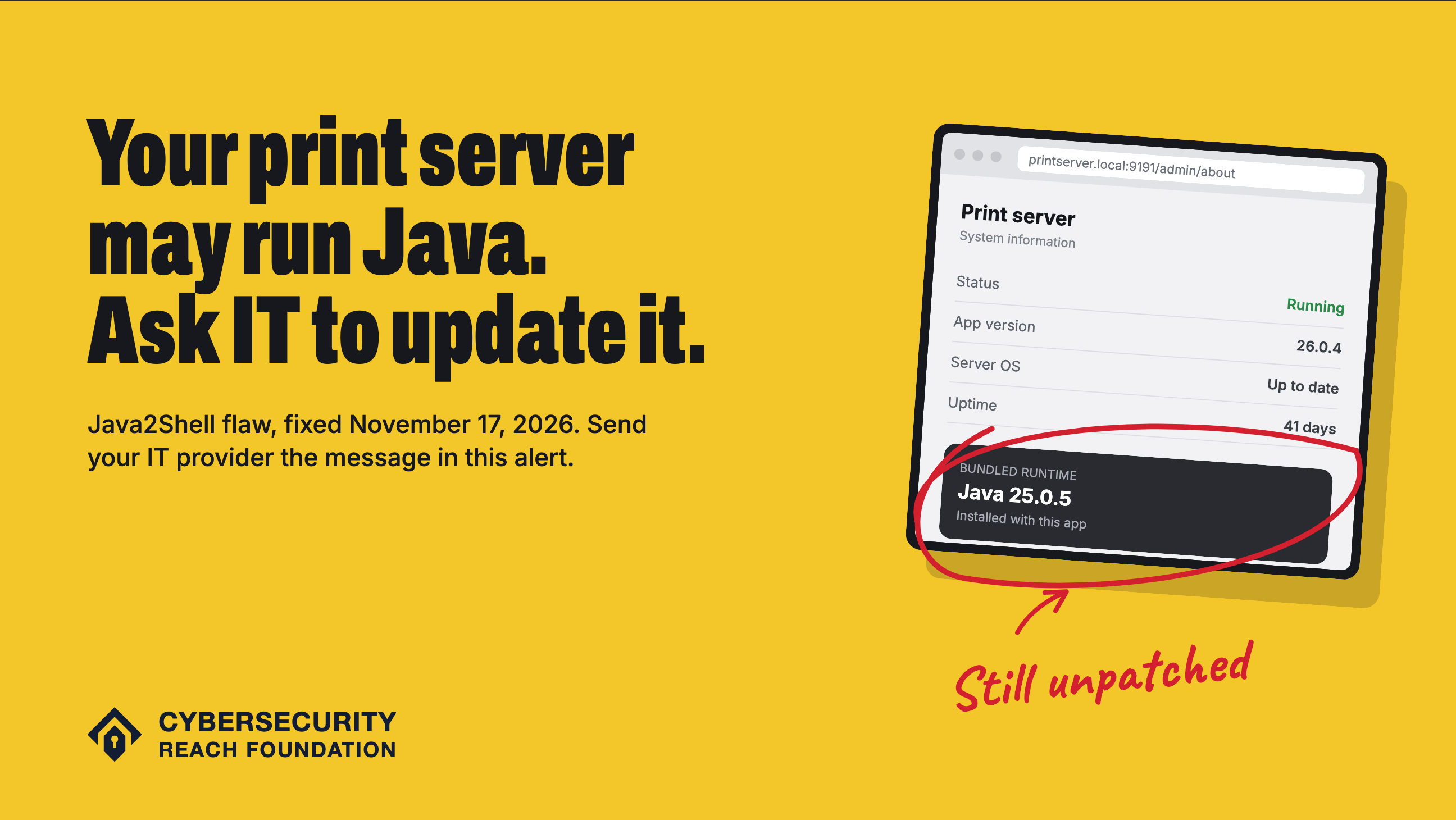
Your business may be running Java without knowing it. A flaw fixed on November 17 can let attackers crash or break into office systems built on it, and fixing it takes an update and a restart.
Most owners never install Java. It comes built into other software: the system that manages your office printers, the controller for your Wi-Fi, the project tracker your team logs into, or the booking page a developer built for you. On November 17, Oracle fixed a flaw in Java called Java2Shell (also known as Java4Shell). Researchers used it to take over popular business tools without a password.
For your business, that means two risks. An attacker can easily knock these systems offline, so printing, Wi-Fi management or your team's tools stop working. In some products an attacker can go further and take control of the server, along with whatever is stored on it. Java flaws have been used in ransomware attacks before.
No successful attacks have been confirmed, but security researchers have already seen attackers start trying.
At a glance
- Who should care: any business that runs software on its own computer or server, in the office or rented in the cloud, rather than only using websites it logs into.
- What could happen: systems stop working; in some products an attacker takes over the server.
- What fixes it: an update and a restart. Plan it for after hours.
- Who does it: your IT provider, or whoever set the system up.
Do you have any of these?
- A print system where staff log in or badge at the printer, or that tracks who prints what. PaperCut, a common one, has confirmed that some of its versions are affected.
- Ubiquiti UniFi Wi-Fi managed by software installed on an office PC or server.
- Jira, Confluence or Jenkins installed on your own server. If you use the cloud versions, the vendor handles it.
- A custom website, booking system or customer portal a developer built for you.
- A Minecraft server you run for customers, a club or a camp.
If you're not sure, that's normal. The message below asks your IT provider to check for you.
If everything your business uses is a website you log into, such as Microsoft 365, Google Workspace or QuickBooks Online, the company that runs it is responsible for updating it.
Send this to your IT provider
Subject: Java2Shell (CVE-2026-114938): please check our systems
Hi [name], a critical flaw in Java called Java2Shell or Java4Shell (CVE-2026-114938) was fixed on November 17. Can you check whether any of our systems run Java 17 or newer, including software that comes with its own copy of Java, such as our print server or Wi-Fi controller? Please update and restart anything affected, apply the temporary setting where no update is out yet, and let me know by [date] what you found and what you changed. Thanks.
Ask for the answer in writing, so you have a record of what was checked.
If you don't have an IT provider
Call whoever set up the system, or the vendor's support line listed on its official website. Do not download tools that claim to check for the flaw: fake ones that install malware are common after big security announcements.
For your IT provider
- Affected: Java 17.0.6 and later, plus 21, 25 and 27, before the November 17 update, from every vendor (Oracle, Temurin, Corretto, Zulu, Microsoft, Red Hat and others). Standard Java 8 and 11 are not affected.
- Hardware: only x86-64 CPUs with AVX-512 VBMI run the vulnerable code: Intel Xeon Ice Lake and newer, AMD EPYC and Ryzen Zen 4 and newer. ARM64 is not affected. Check with
grep -o avx512vbmi /proc/cpuinfo. - Bundled runtimes: products that ship their own Java are not fixed by OS updates. PaperCut NG/MF Application and Site Servers 25.0.0 to 25.0.13 and 26.0.0 to 26.0.6 are affected (24.x and earlier are not); follow PaperCut's advisory. A UniFi user reproduced the memory corruption on the JDK 25 bundled with UniFi Network; Ubiquiti has not published guidance yet.
- Products with demonstrated pre-auth takeover: Keycloak, Jira, Confluence, Jenkins, JFrog Artifactory and PingFederate. Tomcat, Spring Security and Jetty Basic authentication have also shown pre-auth paths.
- Stopgap: add
-XX:-UseBASE64Intrinsicsto the JVM options and restart; confirm withjcmd <pid> VM.flags. As of November 18, Debian and Ubuntu OpenJDK packages were not yet fixed, soapt upgradealone does not protect you. - Clients too: Java programs that make outbound TLS connections can be attacked by a malicious server.
- Signs of attempts: unexpected JVM crashes and
hs_err_pidfiles on AVX-512 hosts.